The OrderPort Restaurant application is compatible with the OpenEdge payment processor. The application is available exclusively on Apple iOS devices running iOS 13 or later. If you are utilizing Worldpay, please refer to the OrderPort Restaurant WP Guide. If you are using OrderPort Payments powered by Stripe, please consult the OrderPort Restaurant Two Guide. Please note: This application is no longer being maintained.
TABLE OF CONTENTS
- Downloading the App
- Point of Sale Settings
- Text Modifiers Setup
- Modifier Setup
- Connecting Products to Printers
- Signing in
- OrderPort Restaurant Point of Sale Overview
- Types of Transactions
- Seating a Guest
- Running a Transaction
- Standard Payment Methods
- Other Payment Methods
- Selling Gift Cards
- Reservations
- Creating a Customer Account
- Adding a Wine Club Member
- Shipping an Order
- Updating and Reviewing Customer Accounts
- Releasing Pickup Orders
- Refunding a Transaction
- Editing an Order
- Physical Inventory Count
- Clock In / Clock Out
- Drawer Open
- Drawer Close
- Reports
- Devices
- FAQ's
Downloading the App
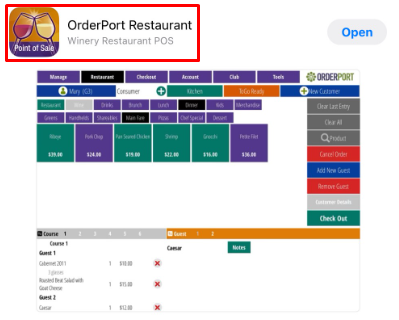
To download the app on your Apple device, navigate to the App Store. In the search bar, type OrderPort Restaurant. The application icon will be Orange in color.
Point of Sale Settings
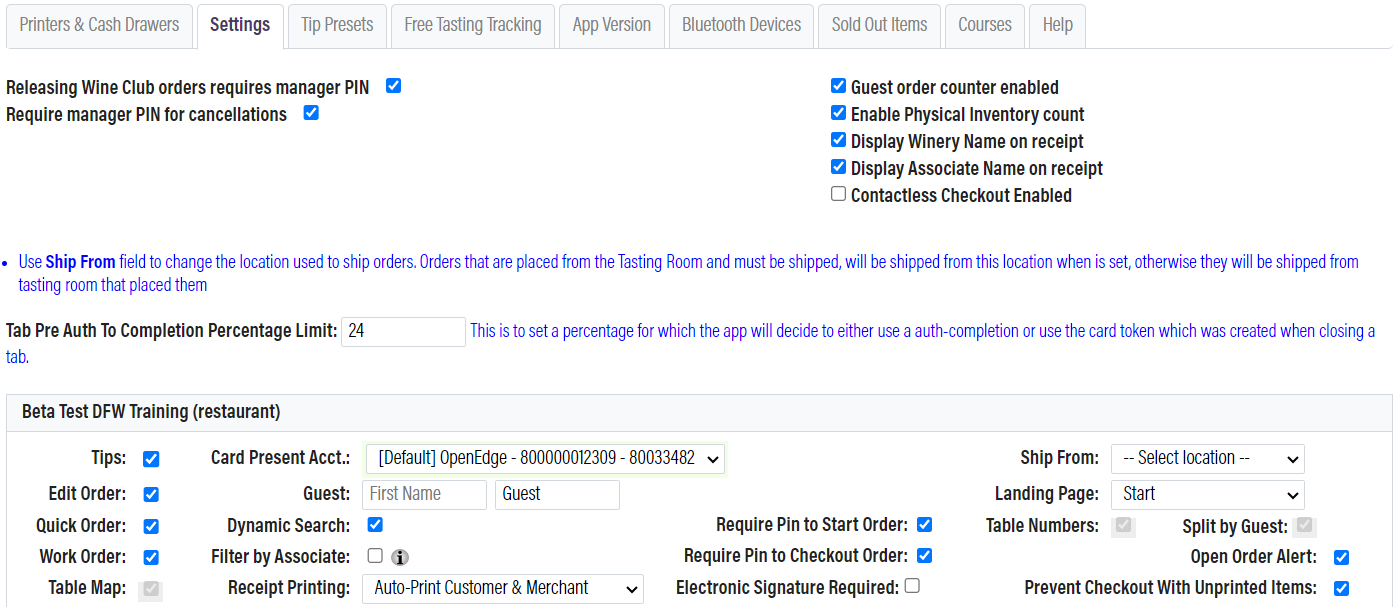
Prior to logging in, you will need to configure the Point of Sale settings. These settings can be found in OrderPort Administration > Services > Point of Sale > Settings. They allow you to control certain functionality within the app. We recommend watching the related video on OrderPort University for additional guidance.
At the top of the screen are Universal Settings, which apply to all tasting room and restaurant locations. Below are the Individual Location Settings, which allow you to customize settings for each business location independently. If a location is designated as a restaurant, the word (restaurant) will appear in parentheses next to the location name.
If any changes are made to these settings, you must fully sign out of the OrderPort app on all devices and then sign back in for the updates to take effect. To do this, navigate to the Manage screen and select the red Sign Out button in the upper-right corner. Once you sign back in, the changes will be applied.
Universal Settings
The checkboxes at the top of the page affect the behavior of all tasting rooms and restaurant locations.
- PIN Settings: Located on the left side. These settings require certain actions to be approved using a manager PIN.
- Guest Order Counter: Guests without accounts are given a default name. This setting helps distinguish between multiple guests with the same name by adding a number.
- Physical Inventory Count: Allows inventory counts to be completed directly from the device. These counts are imported into OrderPort Admin, where a manager resolves any discrepancies.
- Receipt Options: Customize whether the winery name and associate name are displayed on the receipt.
- Prevent opening orders created in a different app: If your winery uses the Resurant application in addition to OrderPort 5, this setting should be enabled to prevent Resturant Orders from being opened on OrderPort 5.
Contactless Checkout
One of the Universal Settings is called Contactless Checkout. We strongly recommend all wineries have this setting enabled. Please note: This has nothing to do with the tap-to-pay features.
When enabled, the following workflow will be used: Checkout Page -> Tip Screen -> Payment -> Completion.
When disabled, the following workflow will be used: Checkout Page -> Payment Tip Screen -> Completion.
Please note: When disabled, the payment processor will be called twice, once for the initial payment and a second time in order to add the tip charge. There are additional risks that come with this. To learn more about them, please see the Backend POS Payment Processing Details document.
If you update the setting, make sure to save the change. You will need to close and reopen your OrderPort Point of Sale app for the change to take effect.
For a video demonstration of the different workflows, please see this OrderPort University lesson: Contactless Checkout Setting.
Location Settings
- Tips: Enables or disables tips.
- Edit Order: Enables or disables order edits at the point of sale.
- Quick Order: A legacy option that is no longer relevant.
- Work Order: Enables or disables work orders.
- Table Map (Required for Restaurant): Allows you to set up a seating area with tables and chairs on a virtual map. This map is a separate screen viewable from the Manage page. Tapping a table starts a new order at that table. This setting requires Table Numbers to be enabled.
- Card Present Account: The credit card processing account used by the point of sale.
- Guest Name: The default name given to customers without accounts.
- Dynamic Search: Updates search results as you type. If disabled, results will not display until the search button is pressed.
- Filter by Associate: When enabled, active carts displayed on the Manage screen are filtered by user.
- Receipt Printing (Restaurant Only): Can be set to automatically print merchant and/or customer receipts. This setting is ignored if Electronic Signature is enabled.
- PIN Options: Require a PIN to start and check out an order.
- Electronic Signature Required: Requires the customer to provide an electronic signature.
- Ship From Location: Selects the default shipping location for orders placed at this location. If left blank, the order will ship from the tasting room.
- Landing Page: The default screen displayed on the Manage page. This is only relevant if Table Maps are enabled.
- Table Numbers (Required for Restaurant): Allows associates to assign table numbers to each order.
- Split by Guest (Required for Restaurant): Allows customers to split orders into separate bills by guest. Requires Table Numbers to be enabled.
- Prevent Checkout with Unprinted Items: Kitchen and Bar designated items must be printed to their respective printers to check out the order.
- Suggested Tip Amounts on Customer Receipts (Restaurant Only): Tip amounts will print on the receipt to assist in Tip calculation.
Courses
Courses help your servers organize the items in their orders. They also help the kitchen know which items to prepare first. Courses are things like Drinks, Appetizers, Entrees, and Dessert.
In order to use the OrderPort Restaurant app, you need to set up a minimum of one course. On the Courses tab, select the Add Course button to create a new course.
Open Order Unlock:
The Open Order Unlock feature is highly recommended to be enabled. When this feature is turned on, it prevents another clerk from editing or processing payment on the same order from a different device. This helps prevent orders from becoming corrupted.
When an order is open on one iPad and you attempt to open it on another, you will receive a pop-up warning indicating that the order is locked.
In the Users module, you can enable an account to override this pop-up. It is recommended that only managers have this permission enabled.
Text Modifiers Setup
Text modifiers are used when you need to type a note on a restaurant item. Setting up text modifiers ahead of time saves you time in the long run and allows you to quickly communicate order specifications to the kitchen.
Examples: Rare, Medium Rare, Medium Well, Well Done
Setup Steps
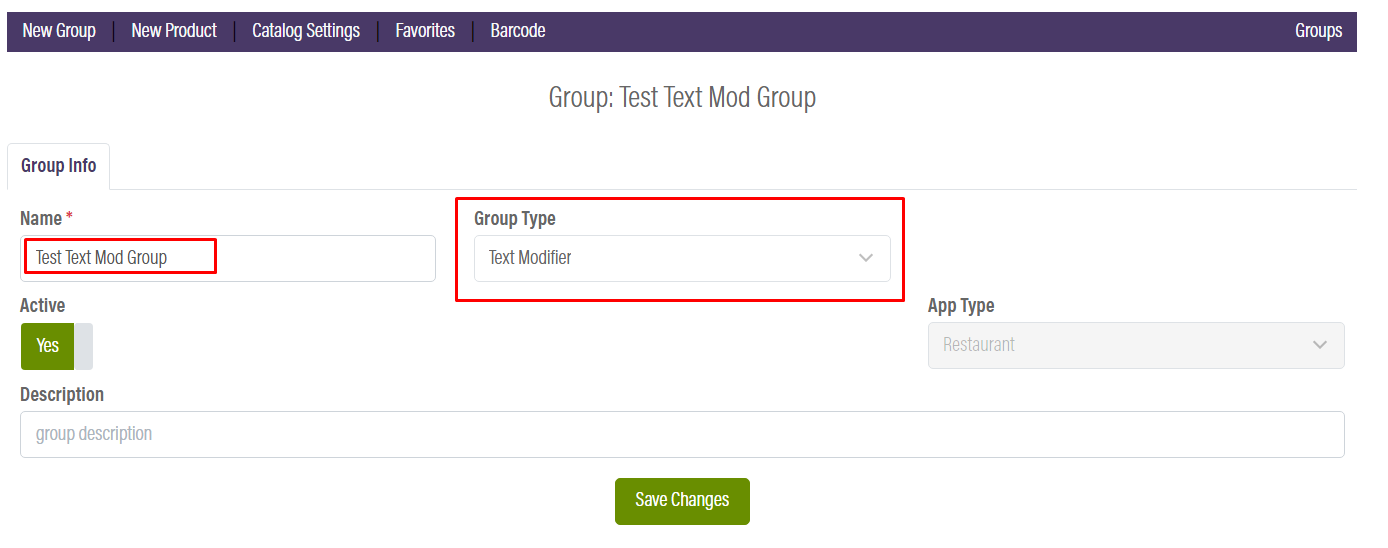
- In Catalog Manager, click New Group.
- Select Restaurant.
- Enter the name of the group and select the Group Type: Text Modifier.
- Click Save Changes.
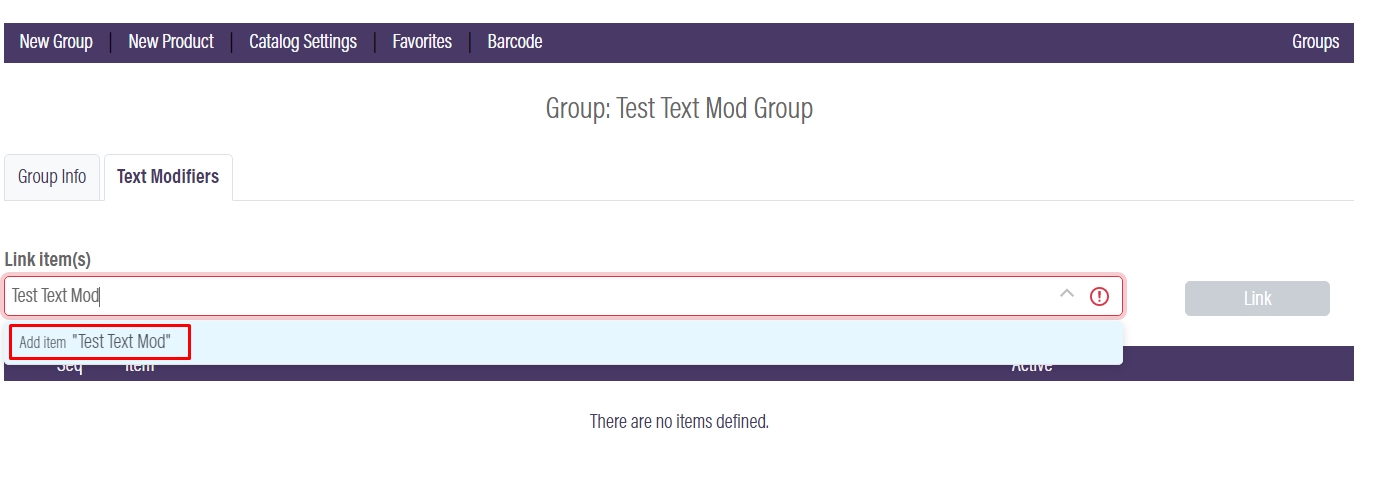
- A new tab will appear—click on it.
- In the Link Item(s) input box, start typing the text modifier you want to add.
- An option labeled Add Item will appear below the input field.
- Click Add Item. You can add multiple text modifiers at once; just be sure to click Add Item for each one.
- Once you click Link, a Save Changes button will appear. Click Save Changes to finalize.
Modifier Setup
Modifiers are physical items that customers can add to or swap into their order, which may incur an additional charge. Setting up modifiers ahead of time saves you time in the long run and allows you to quickly communicate order details to the kitchen. Watch this OrderPort University Video.
Examples: Bacon, Tomato, Onion, Ice
Setup Steps
- In Catalog Manager, click New Group.
- Select Restaurant.
- Enter the name of the group and select the Group Type: Modifier.
- Click Save Changes.
- Click New Product.
- Set the item type to Physical and complete the product information.
- Click Groups and Subgroups and add the item to your modifier group.
Applying a Modifier or Text Modifier to a Group
- In Catalog Manager, select the Groups button.
- Click View/Edit on the desired restaurant group.
- Navigate to the Modifiers or Text Modifiers tab, and under Link Items, search for the modifier or text modifier group.
- Click on the group, link the product, and then click Save Changes.
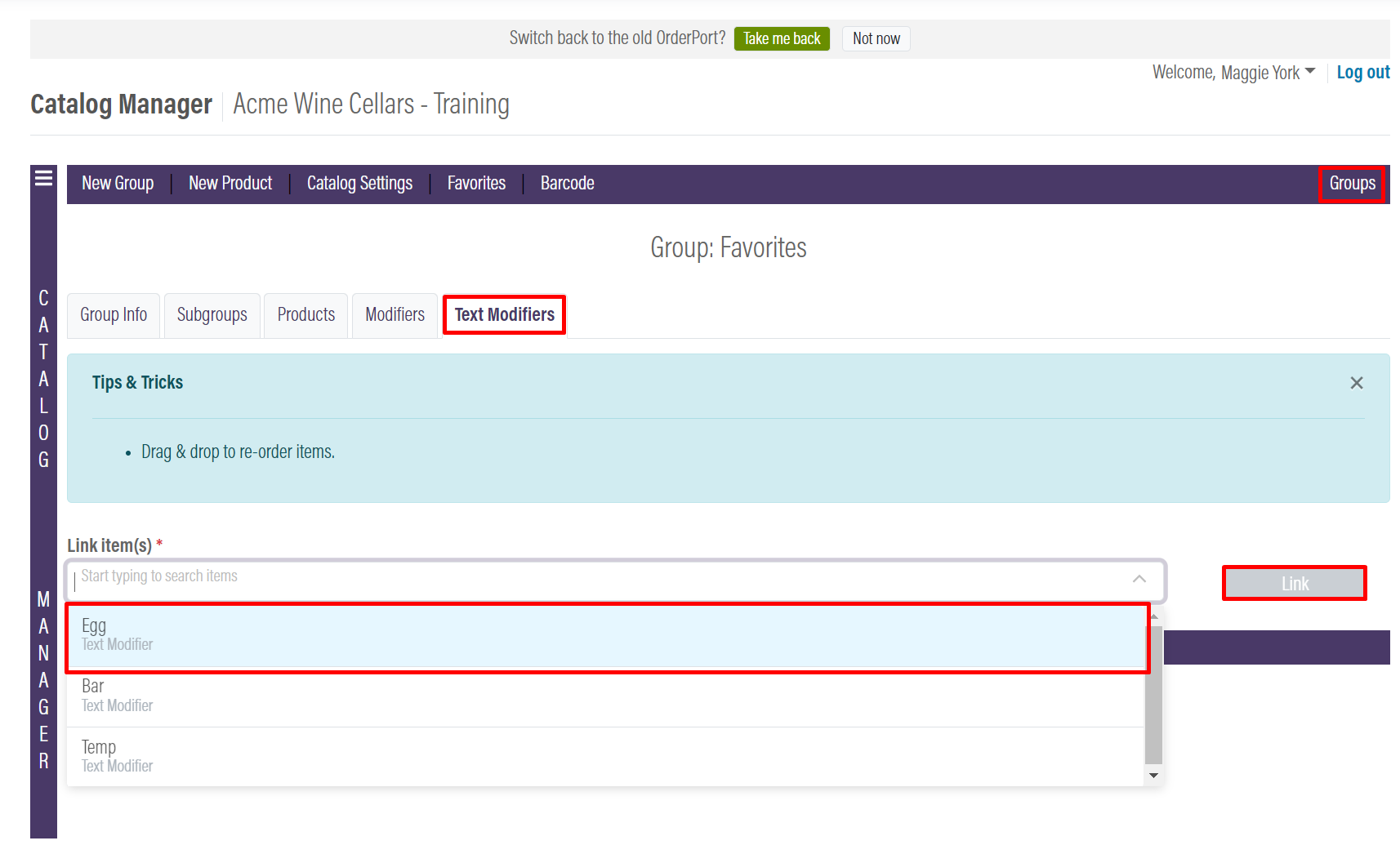
Applying a Modifier or Text Modifier to a Product
- In Catalog Manager, search for the desired product and navigate to the Product Info tab.
- On the right-hand side, under Select Image, click Manage Modifiers and Required Items.
- Click Add Item, choose the type of modifier and the group you want, and then click Save Changes.
- Be sure to save changes on the product as well.
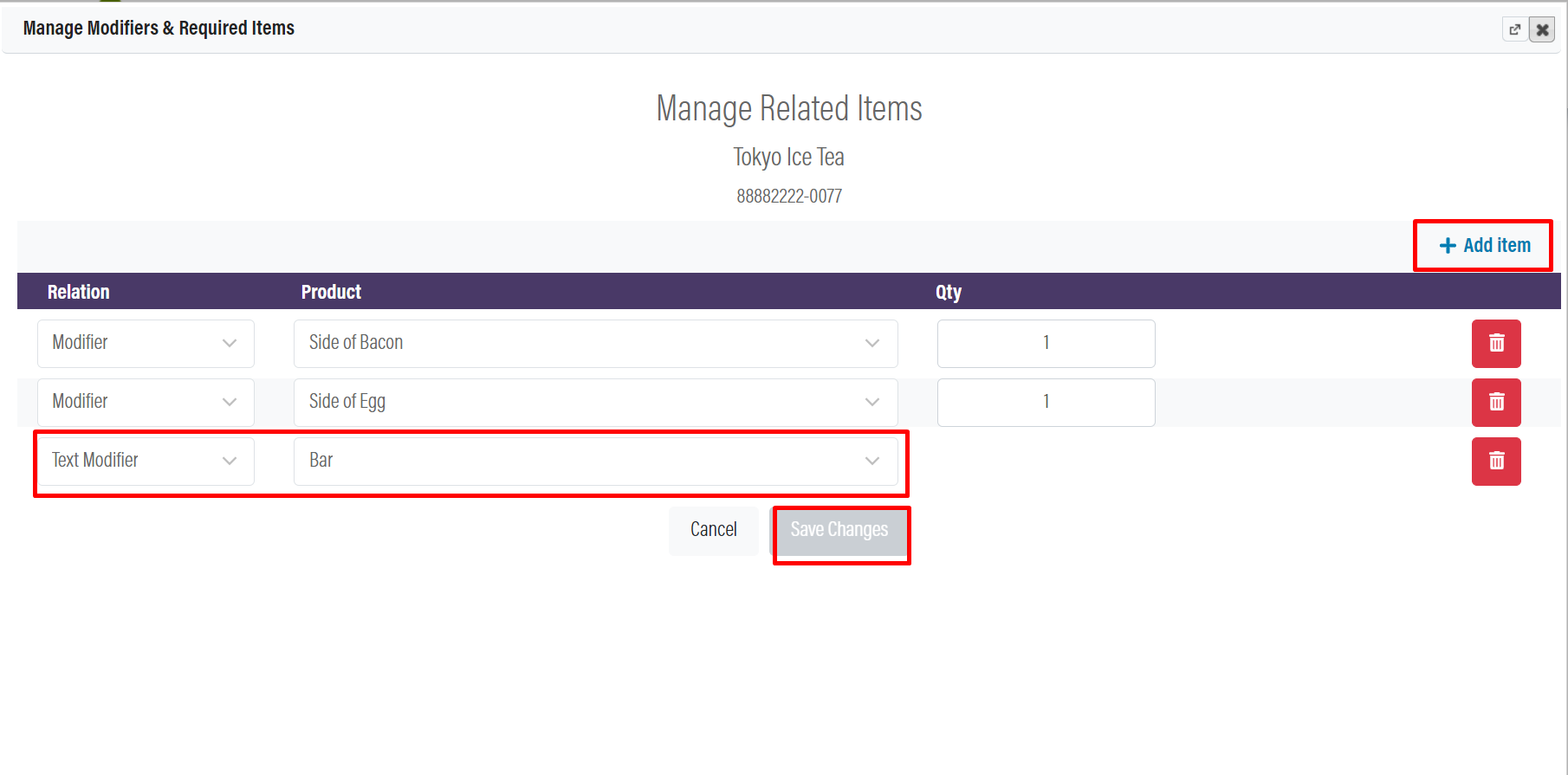
Connecting Products to Printers
In OrderPort Restaurant, you can specify which products print to specific kitchen and bar printers. To configure this, navigate to OrderPort Admin > Point of Sale Module > Printers and Drawers. Ensure that all printers are configured with Cloud Print before proceeding with this step. OrderPort restaurant is solely compatible with cloud printing services. Please refer to this guide for help with this process. https://orderport.freshdesk.com/a/solutions/articles/72000647058
Click the Details drop-down for the desired printer, then select Products.
From here, you will see a list of all linked products. A product can be linked to multiple printers of the same type. You can use the Linked Items field to scroll through all available items or search by product name.
If you want to filter the products that appear in the list, use the Groups field to search for specific Catalog Manager groups. This allows you to quickly link all items within a group to a printer—for example, linking the Salads group to the Salad Printer.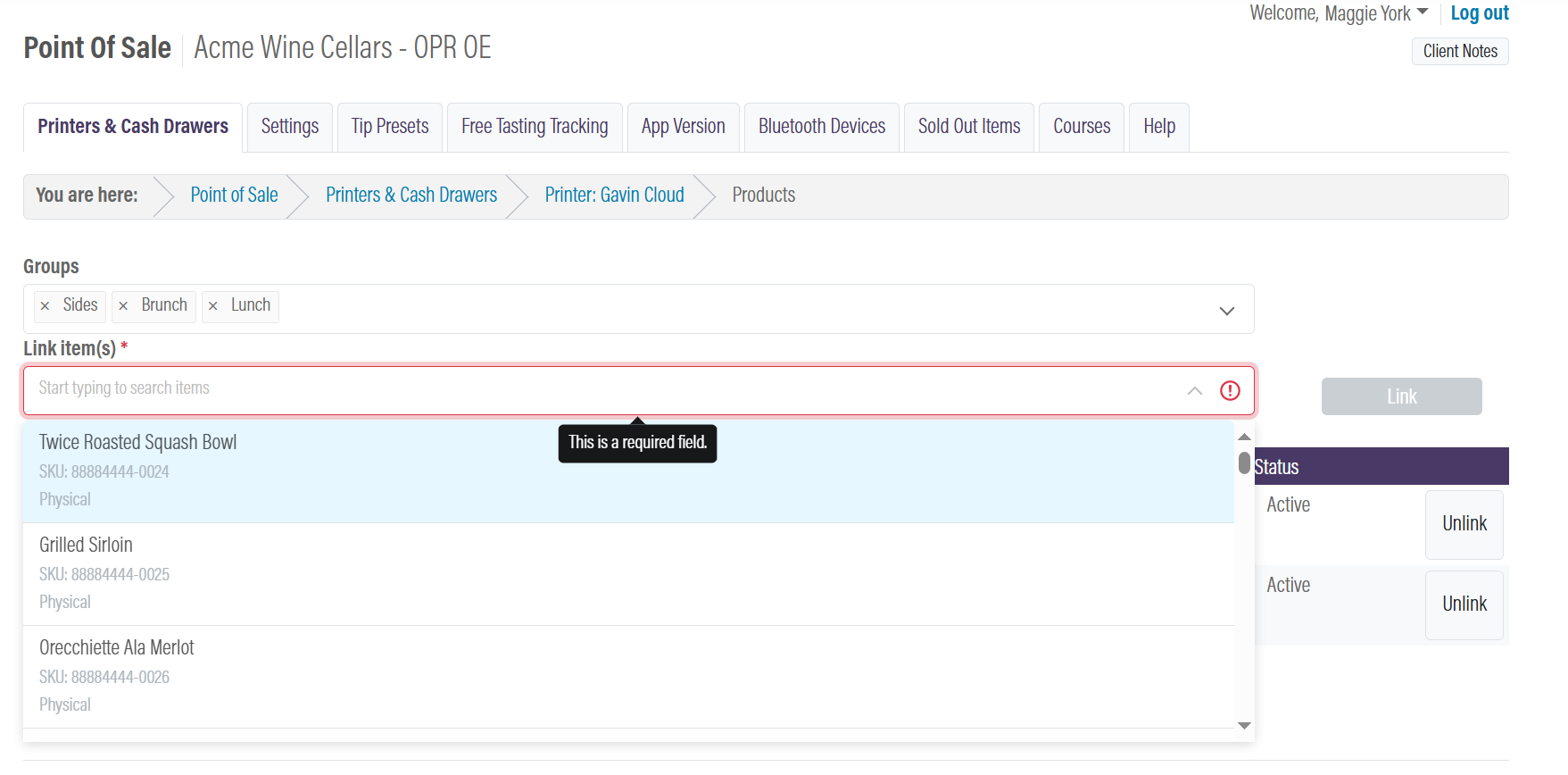
After you have selected all the desired items, click the Link button to add them to the printer. If you need to remove an item, select it and click the Unlink button.

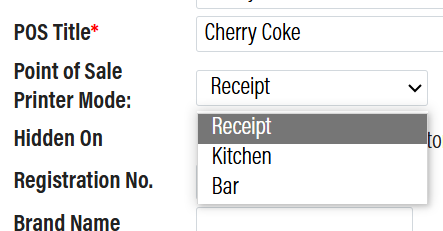
Please note: Products must already have the correct printer type assigned in Catalog Manager. If the printer type does not match, the product cannot be linked. For example, if the selected printer is a Kitchen Printer but the product is set as a Bar type, the system will not allow the link.

To change the printer type for a product, navigate to
OrderPort Admin > Products > Catalog Manager, select the desired product, and open the Product Details page. From there, update the Point of Sale Printer Mode drop-down to the appropriate printer type.
Signing in
After downloading the OrderPort Restaurant app on an Apple device and opening it, you will be prompted to enable the Local Network. This feature is required for printer pairing. After selecting Yes, you will use your OrderPort Administration login to access the app. You will be asked to enter a username, password, and PIN. If you need assistance obtaining these credentials, please contact helpdesk@orderport.net.
After logging in for the first time, the app will also prompt you to enable Bluetooth. This is required for pairing card readers and barcode scanner devices. You will then be asked if you would like to pair your card reader immediately. If you choose to do so, please review the Card Reader Pairing and Troubleshooting Guide.
After selecting No, or after successfully pairing the card reader, the app will prompt you to select any available printers or cash drawers you would like to connect. If you wish to set this up later, you can select the X in the upper-right corner of the yellow pop-up.
OrderPort Restaurant Point of Sale Overview
Prior to creating any orders on the Restaurant app, please watch this OrderPort University Training. The OrderPort Restaurant is organized into six different pages:
- Manage page
This is the page you will see when you first log into the app. From here, you will start new orders and view open orders. You also have access to a variety of buttons on the right. - Shop page
This page is used to add products to orders. Whenever you open an order in the Manage page, you will be brought to the Shop page. - Checkout page
This page is used to take payment for orders. - Account page
This page is used to manage customer accounts. - Club page
This page is used to register customers for your wine clubs. - Tools page
This page is used for administrative tasks. App settings can also be configured here.
Manage Page
The Manage screen is the home page of the OrderPort app. From here, you can manage orders, employees, and access all other features provided by the OrderPort Restaurant app. This screen is divided into three main sections: Top Navigation, Side Navigation, and the Order Manager.
Top Navigation:
This purple bar allows you to switch between the different point-of-sale tabs, including Manage, Shop, Checkout, Account, Club, and Tools. Each of these sections will be covered in this document.
Side Navigation:
This gray bar provides access to specific tools, including Reservations, Table Map, Drawer, Order Search, Gift Card Balance, and Clock In/Out. It also includes a Clear All button for the Order Search feature. Each of these tools will be covered in this document.
Order List:
This section is divided into two parts: Start Order and Order Navigation. To create an order, use the Start Order feature. If the order is for an existing customer, enter their name next to the Start button. Once you find the customer, tap on their name. If they are not an existing customer, simply select Start. Next, select the number of guests and indicate where they are seated.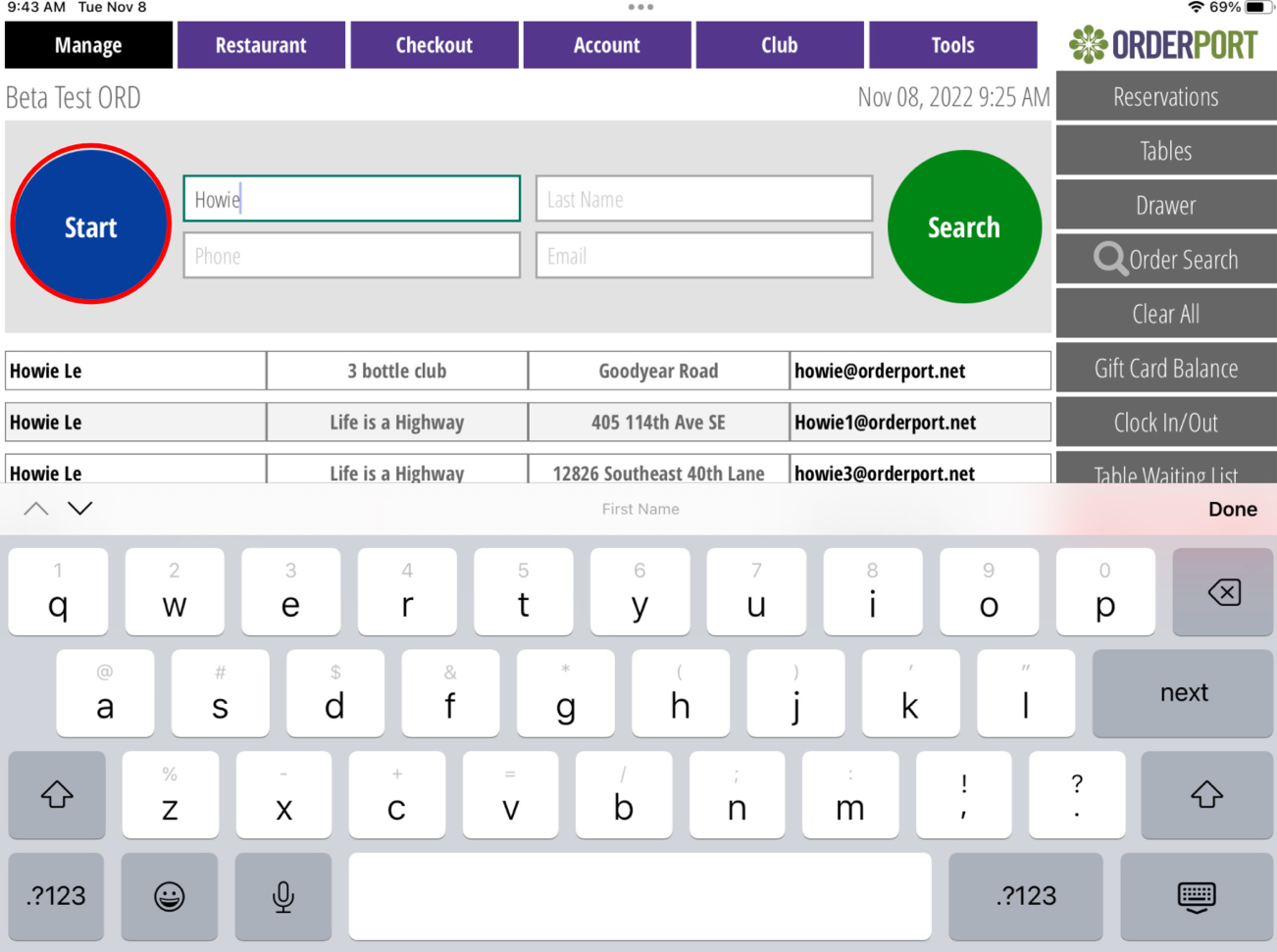
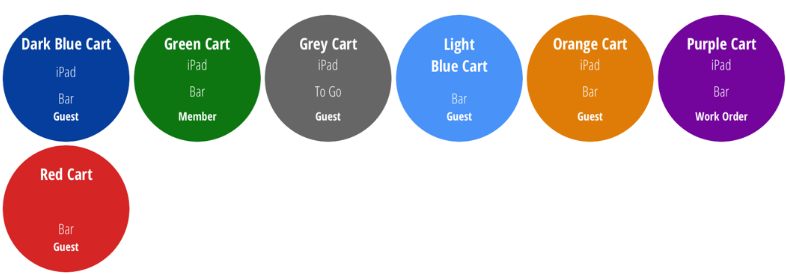
The Order Navigation allows you to view the customer name, seating location, and order type. Since these orders are not yet completed, they are referred to as carts. Each order type is associated with a specific color to help you quickly identify the current status of the order.
On the right-hand side, you will see a gray Filter button.
Filtering
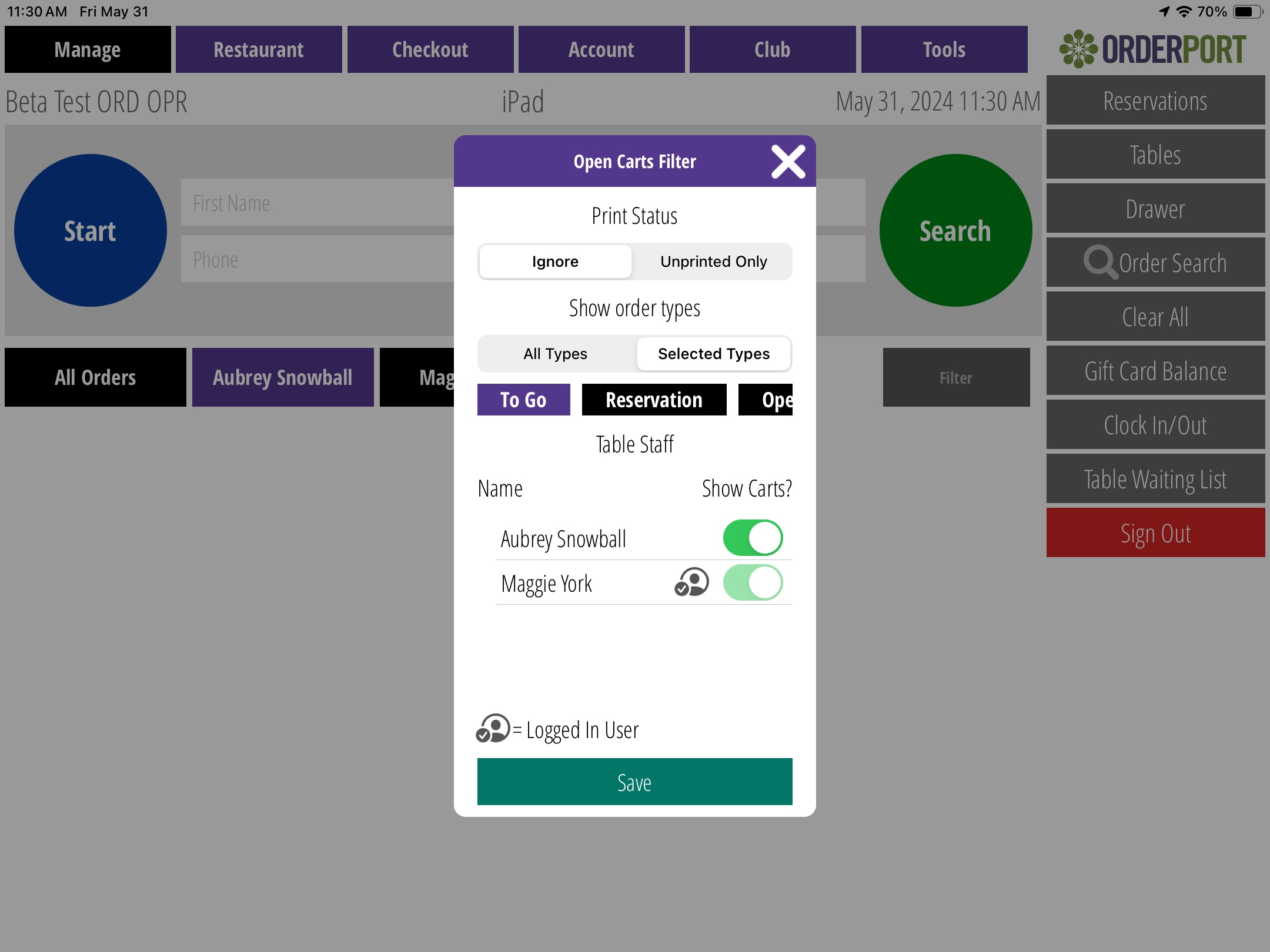
In OrderPort Restaurant, Filter by Associated will always be enabled. On the left-hand side of the Order List page, select Filter. This will open a pop-up window that allows you to filter by Order Type and Staff. To deselect a staff member, tap the green bar next to their name. Please note that you cannot deselect the user who is currently signed in to the OrderPort Restaurant app.
Filtering by Order Type
To filter by order type, click the Selected Types tab. Select the order types you would like to remove from view. Hidden order types will be displayed in purple.
Filtering by Print Status
If Prevent Checkout with Unprinted Items is enabled, a third filtering option labeled Print Status will appear. You can choose to ignore this status or filter by Unprinted Only.
Types of Transactions
Standard Orders
Guest Orders:
To start a guest order, click the Start button on the Manage screen. When viewed from the Manage screen, this order will appear as a dark blue bubble labeled “Guest 1.” As you create additional guest orders throughout the day, the number will increase. This count resets at midnight each day.
Member Orders:
To start a member order, enter the customer’s first name, last name, email, or phone number and click Search. Tap on the customer’s account to start the order. When viewed from the Manage screen, this order will appear as a green bubble with the customer’s name.
Specialty Orders
To-Go Orders:
To-Go orders allow you to take a customer’s order upfront and send them a text message when the order is ready. You can also choose whether to collect payment before or after the items have been received. To use the To-Go Order feature, it is recommended that the Messaging Module is enabled. This option must also be enabled in the Point of Sale settings for the tasting room.
Steps
- Search for a customer to start an order, or start a guest order.
- On the Guest Count pop-up, select the gray To-Go button.
- Add items to the cart.
- If you want to take payment immediately, you must start a tab.
- On the Shop screen, select To-Go Ready to send the customer a text message. (This will only work if the Messaging Module is enabled.)
- Take payment or close the tab.
To enable the messaging module, please contact helpdesk@orderport.net.
Work Orders:
To use work orders, you need to ensure the setting is enabled in the point of sale module for this location. To learn more about work orders, review this OrderPort University Training. When viewed from the Manage screen, this order will appear as a purple bubble with the customer’s name.
When viewed from the Manage screen, this order will appear as a gray bubble with the customer’s name.
Payment Colors
In the OrderPort Point of Sale, a standard or specialty transaction will be overridden by a payment color to help staff quickly identify the current status of an order.
Reservations:
If you have the Reservations Module enabled and start a reservation with a prepaid item, the order bubble will display as light blue. When you check out this order, it will function like a tab, charging any additional amount to the card used to place the reservation.
Tabs:
After starting a standard or specialty order and navigating to the Checkout screen, you will have the option to make the order a tab. This allows you to initiate a payment and complete the checkout after the customer has added additional items. When viewed from the Manage screen, this order will appear as an orange bubble with the customer’s name. Please watch this OrderPort University Video.
Edited Orders:
From the customer’s account history or the Reports page within the Point of Sale, you have the ability to edit an already paid order. When you open this order, you can adjust products, discounts, and more. When viewed from the Manage screen, this order will appear as a red bubble with the customer’s name.
Seating a Guest
Seating a Guest through Order List
Starting an Order
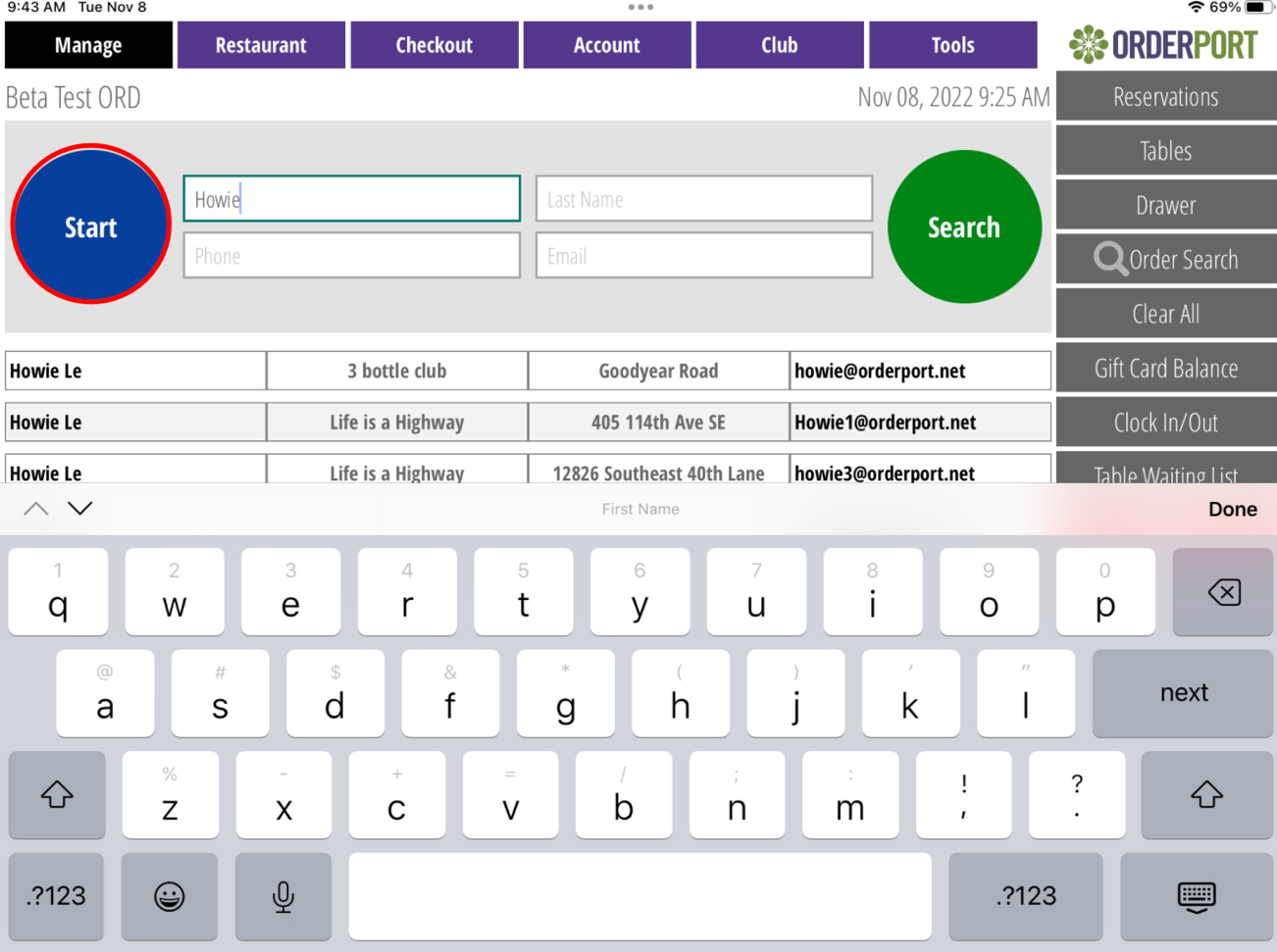
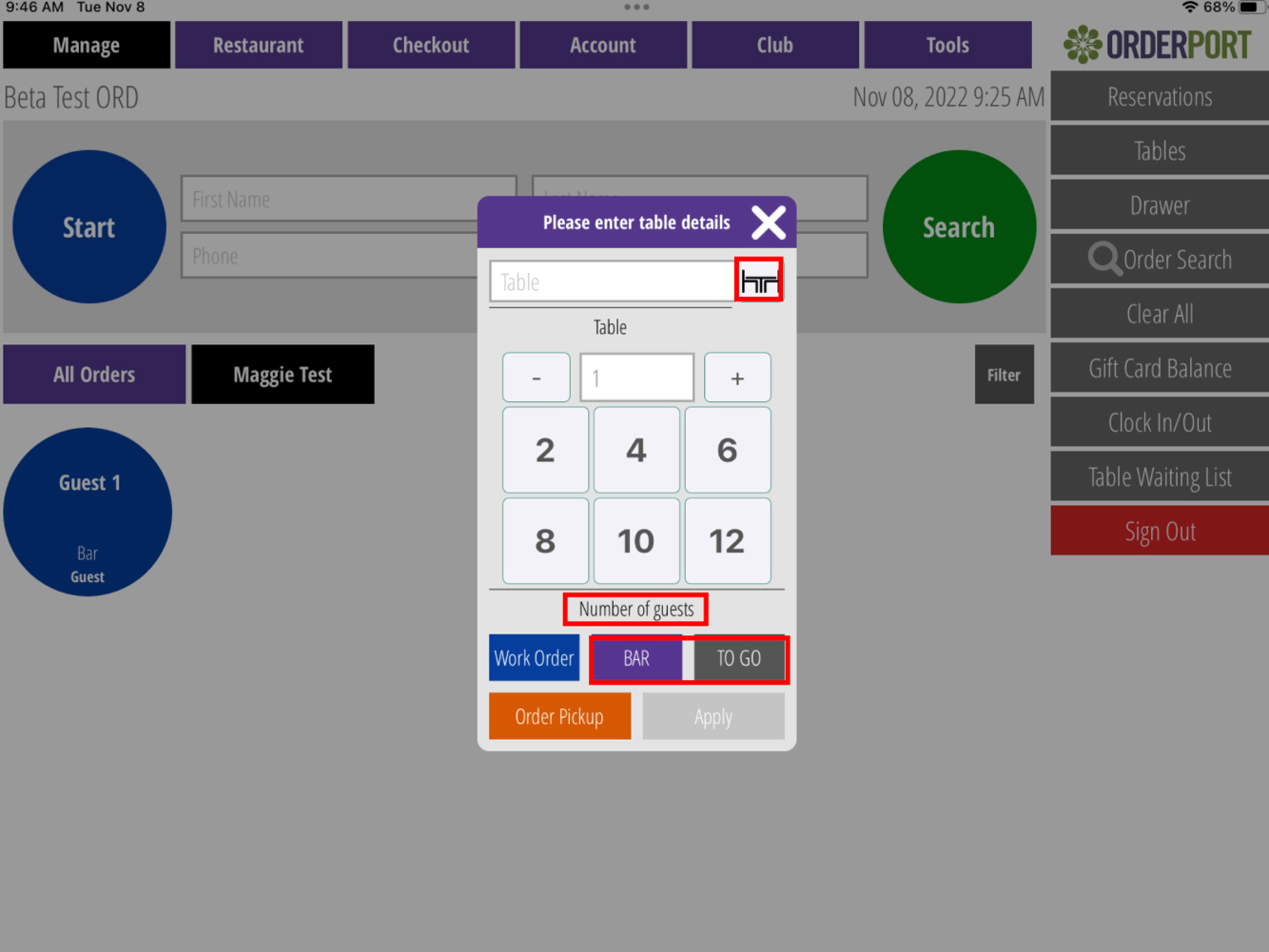
To start an order, navigate to the Manage screen. If the order is for an existing customer, enter their name next to the Start button. Once you find the customer, tap on their name. If they are not an existing customer, simply select Start. Next, select the number of guests and indicate where they are seated.
Selecting Where to Sit
OrderPort offers three seating options for customers. These options will only appear if Table Numbers are enabled. This setting can be turned on in the POS Settings module within OrderPort Admin.
- Table: In the top-left corner of the pop-up, select the table icon to open the table map and choose a table.
- Bar: Seats the customer without assigning a table.
- To Go: Used for to-go orders.
Tables
Table maps are required for all restaurant locations. You can create as many table maps as needed, and they can be set up in the Table Map section of the app. This will be covered later in this document.
The Tables view provides a visual, interactive layout of your seating. To access it in the OrderPort Restaurant app, select the Tables button or open it from the Manage screen, depending on your settings. If you have multiple table maps, the map titles will appear in green at the top of the screen. Tap each title to view the different layouts.
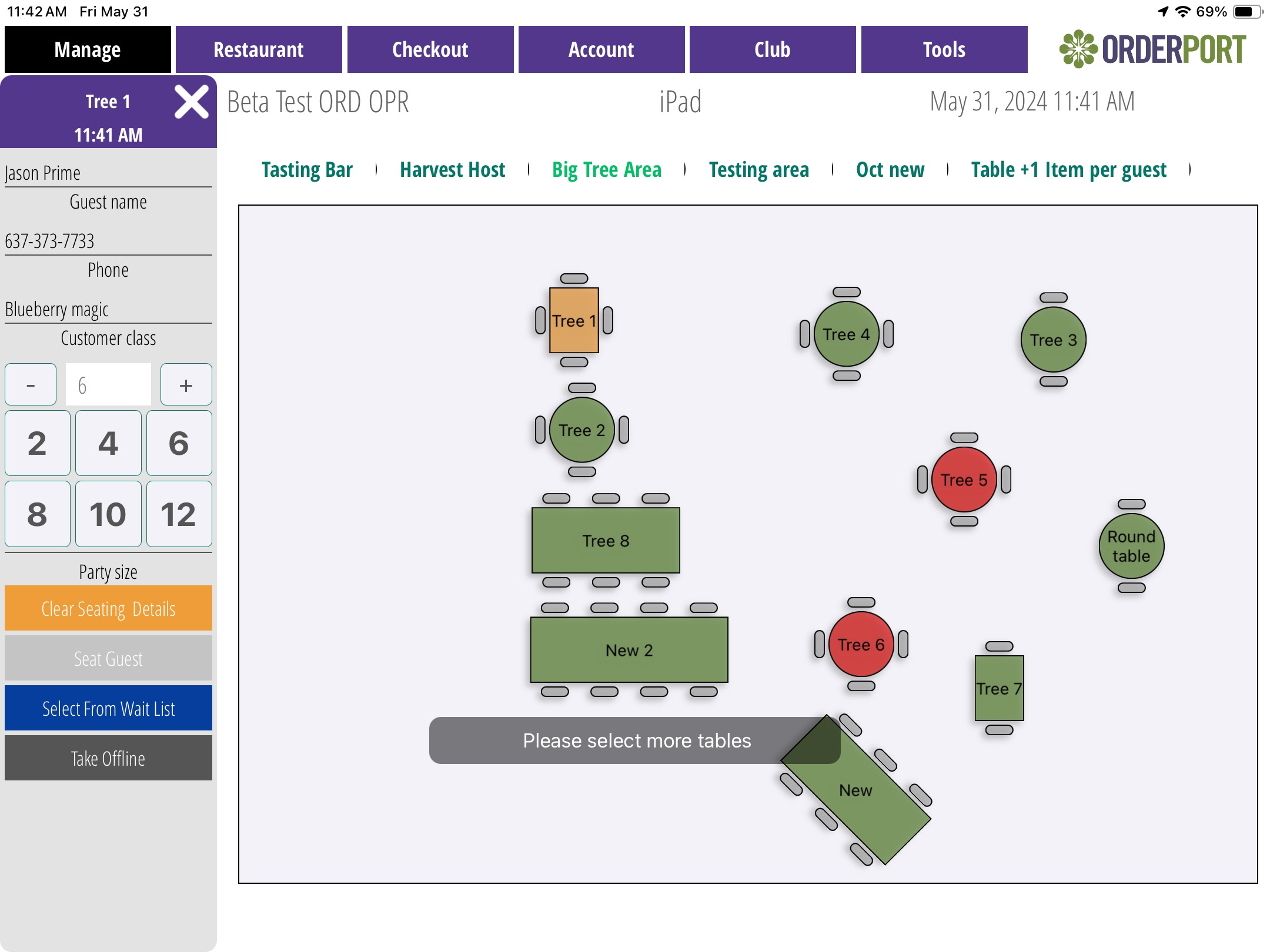
Green tables indicate availability and are ready to seat customers. Selecting a table allows you to search for a customer and enter the number of guests. If you enter more guests than the table allows, the system will notify you to select an additional table or inform you that the table is not combinable. Once all requirements are met, you can proceed to seat the guests.
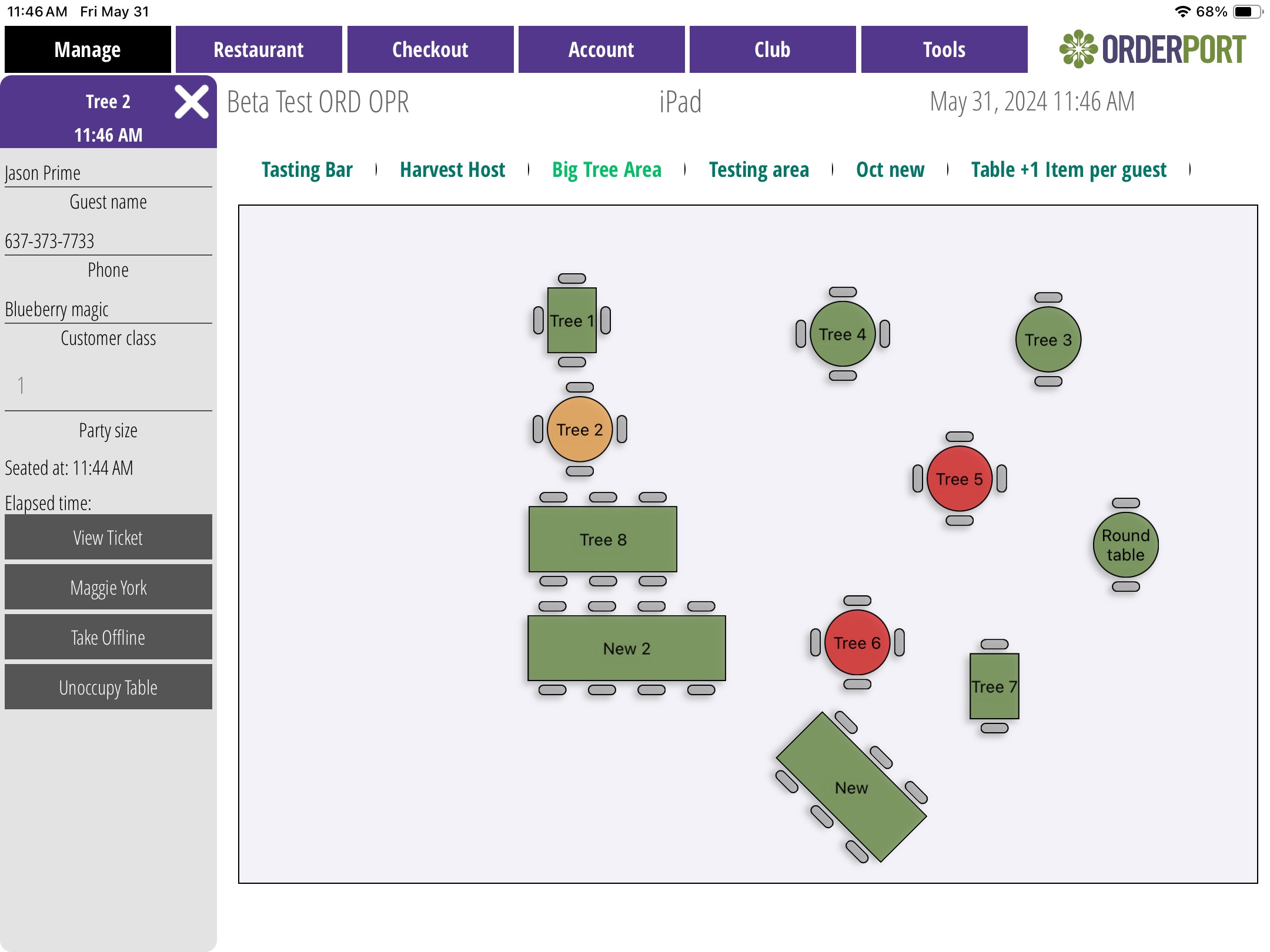
To review or navigate to the order for a specific table, select an occupied table. You will see the customer’s name, the time they were seated, and how long they have been at the table. Select View Ticket to open a pop-up showing all items in the cart and the remaining balance. From there, select the green Open button to access the order.
Starting an Order Through Tables
Selecting Where to Sit
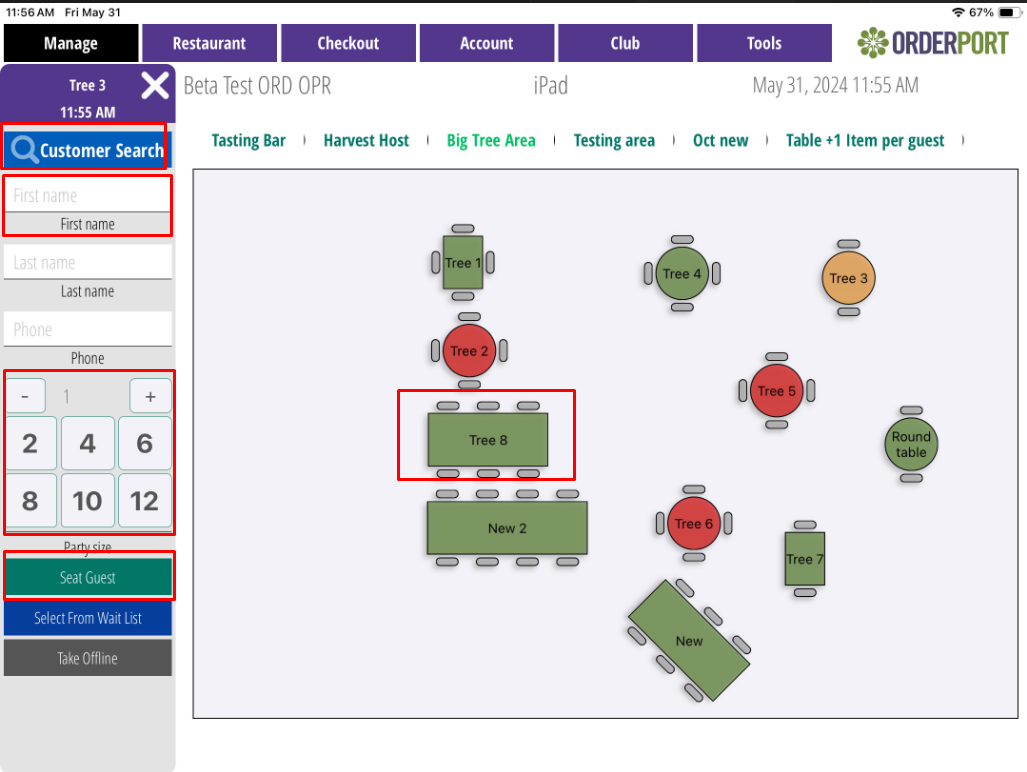
When starting an order through Tables, the first step is to select a table. Browse through the areas and find a green (available) table. Select the desired table, and a pop-up will appear on the left side of the screen. For existing customers: Click the blue Customer Search bar and enter their name. Once you find the customer, tap on their name.
For new customers: Simply enter their name into the fields without using Customer Search. Next, enter the number of guests and select Seat Guest. This will start an order for the customer.
Running a Transaction
Choosing Products: Once the order is started, you will be taken to the Restaurant tab. This tab is divided into two sections:
Left side: Courses where the selected products are displayed.
Right side: Products available to choose from.
Each guest has a base of three courses, but additional courses can be added by selecting the + button. At the top of the page, you will see the groups you created for your restaurant products. Clicking through these groups allows you to find the desired products. You can also use the search feature at the bottom of the page to locate a product. Watch this OrderPort University Video.
Once a product is selected, you will have the option to add modifiers and notes. If the product has any attached modifiers, an orange bar will appear on the bottom right-hand side that says "Add Modifiers." Click the arrow next to this to view all available modifiers. You can select multiple modifiers from the dropdown menu or choose Add Note to add a custom modifier.
From this page, you also have the options to:
- Cancel an order
- Add more guests
- Remove a guest
- View the customer's account
- Use the Wine Menu (which connects to any groups and products set up in OrderPort Five)
Sending Orders to the Kitchen or Bar:
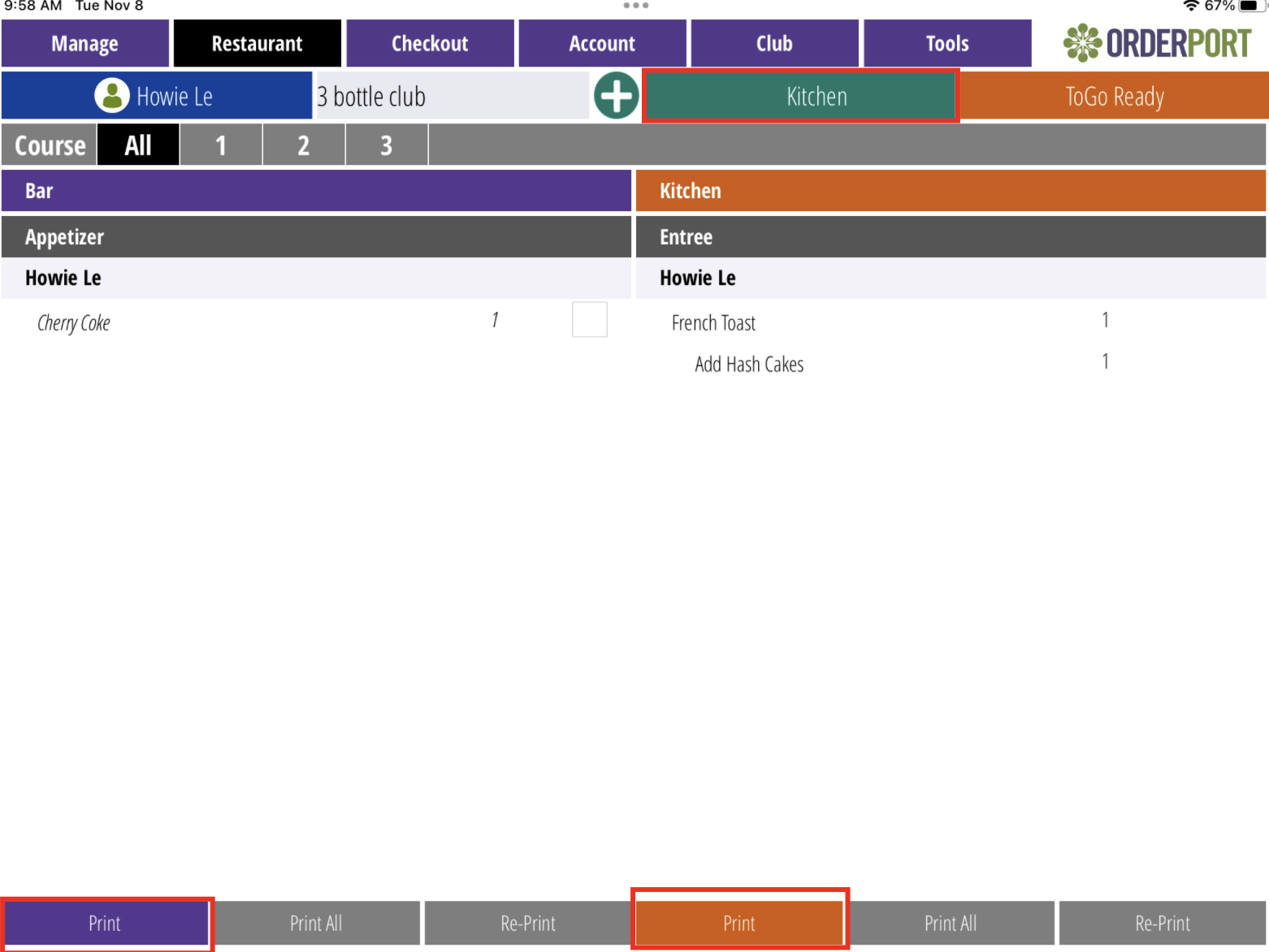
Once products have been selected, click the green kitchen button. The screen will be divided into two sections:
Bar Items: Products here will be sent to your bar printer. Select the purple print button.
Kitchen Items: Products here will be sent to your kitchen printer. Select the orange print button.
Already printed items will appear italicized and will not print again unless Print All is selected. Click the green kitchen button again to return to the product selection page.
Checkout:
Once the customer is ready to check out, click the Checkout button. Any applicable discounts will be automatically applied. To add a custom discount, use the Quick Discount selection. Next, select the method of payment:
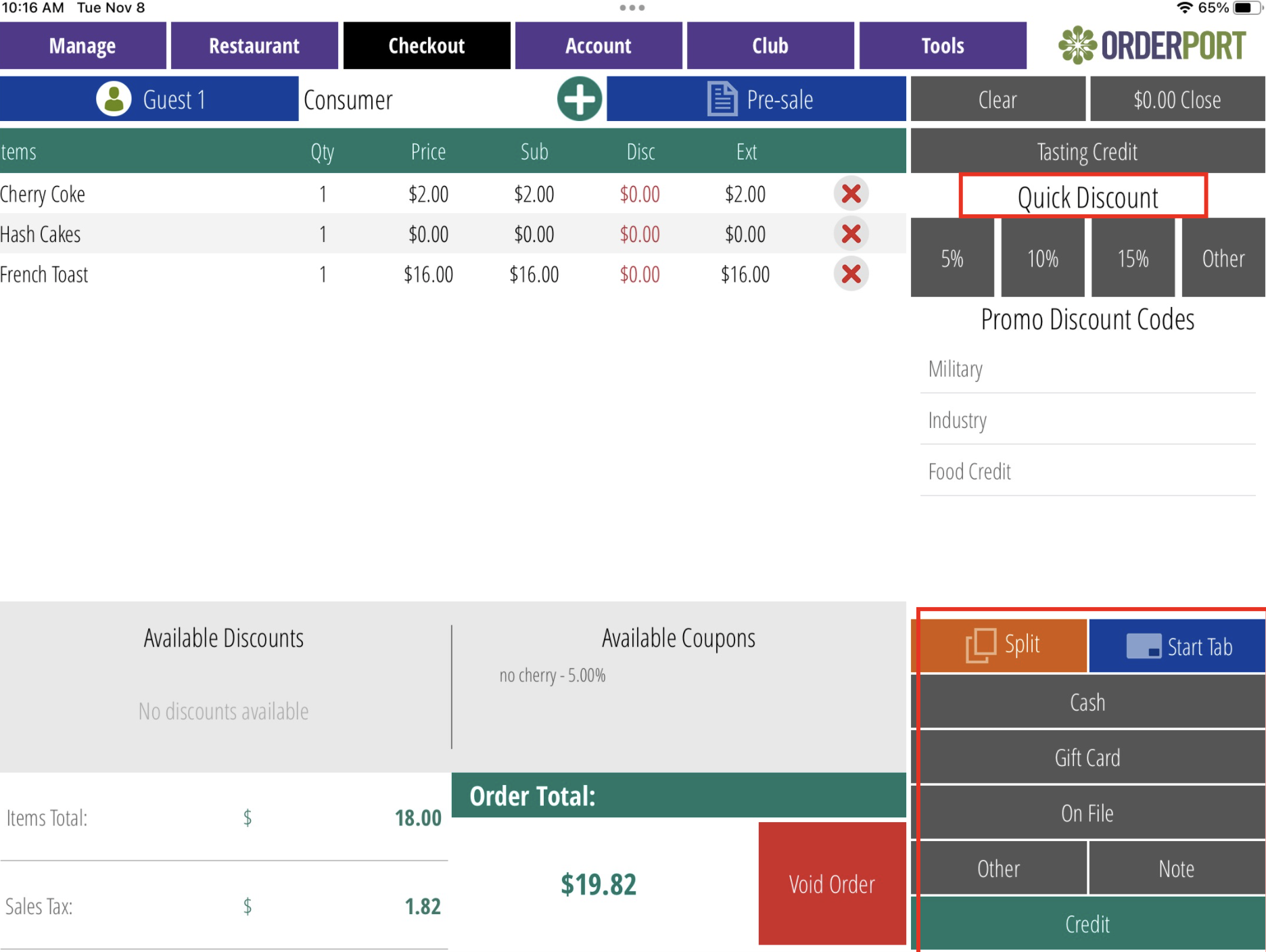
Credit:
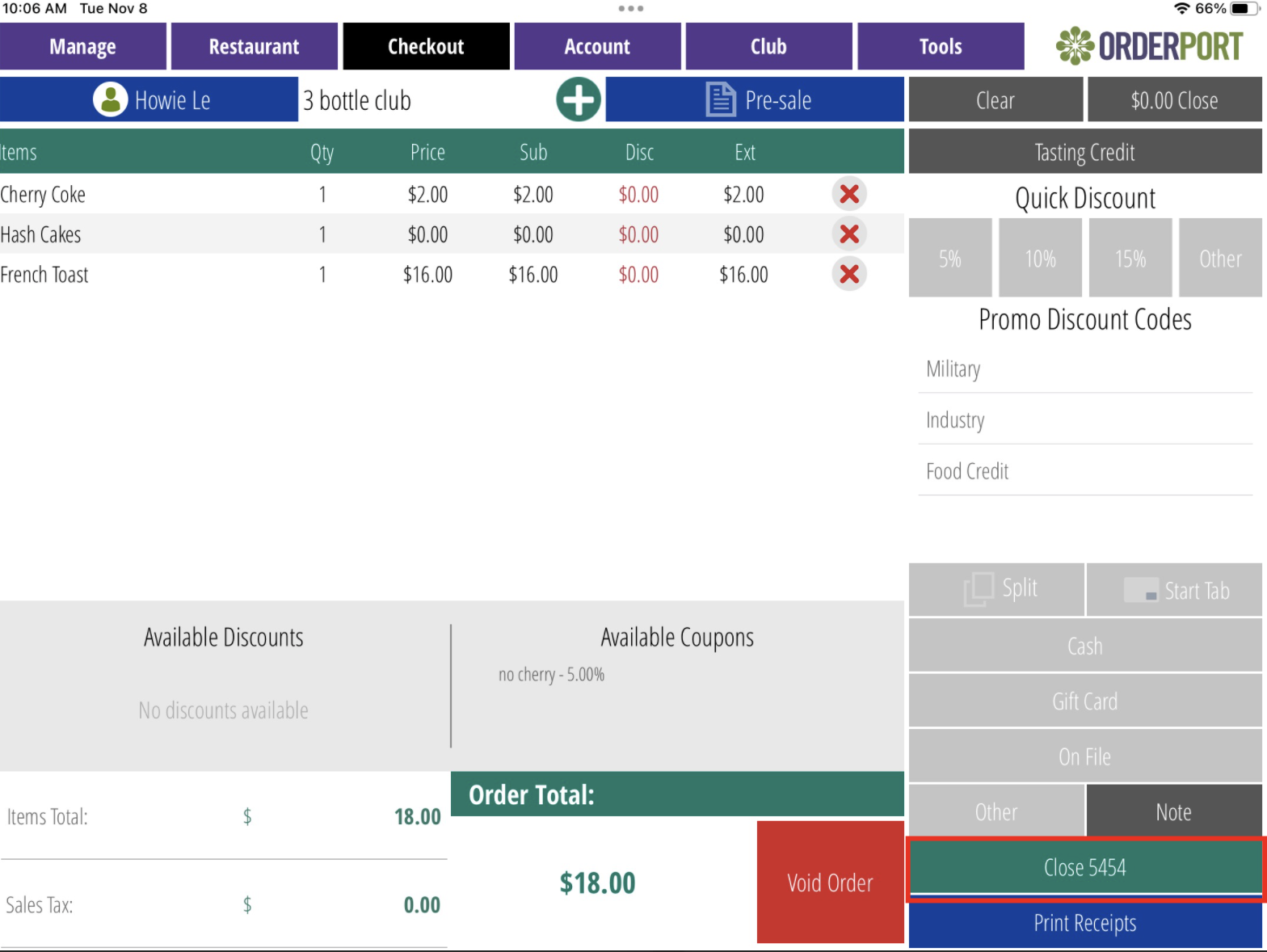
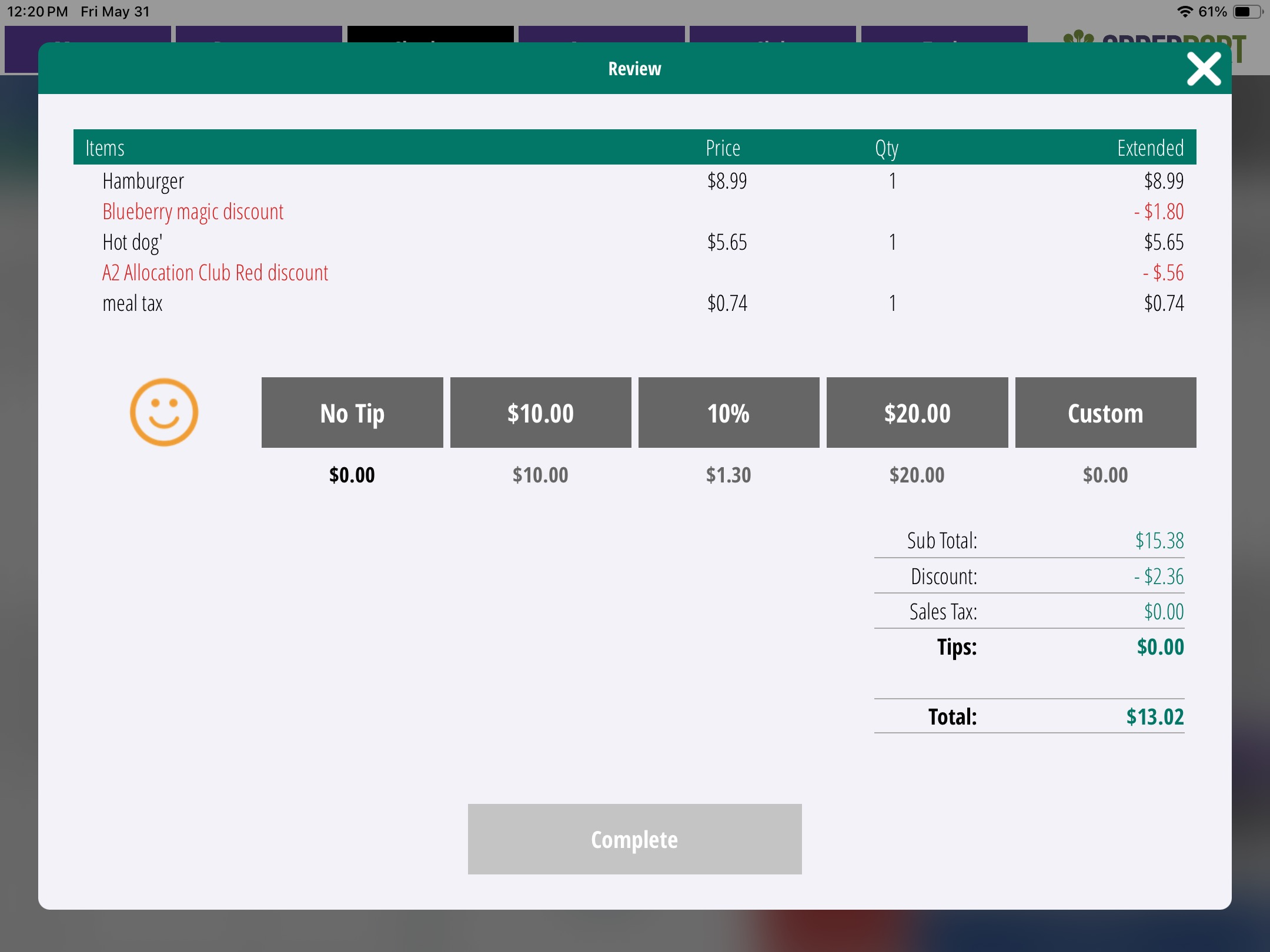
If credit is selected, your printer will print both a customer copy and a merchant copy. Have the customer sign and add their desired tip to the receipt. To close the order, click the green Close button, enter the tip amount, and complete the order.
Card on File:
Tap the On File button on the checkout screen to start a card-on-file transaction. A window will open listing the customer’s saved cards. Tap the card to be used, then tap Submit. Customers can update or remove a card on file from this window if needed.
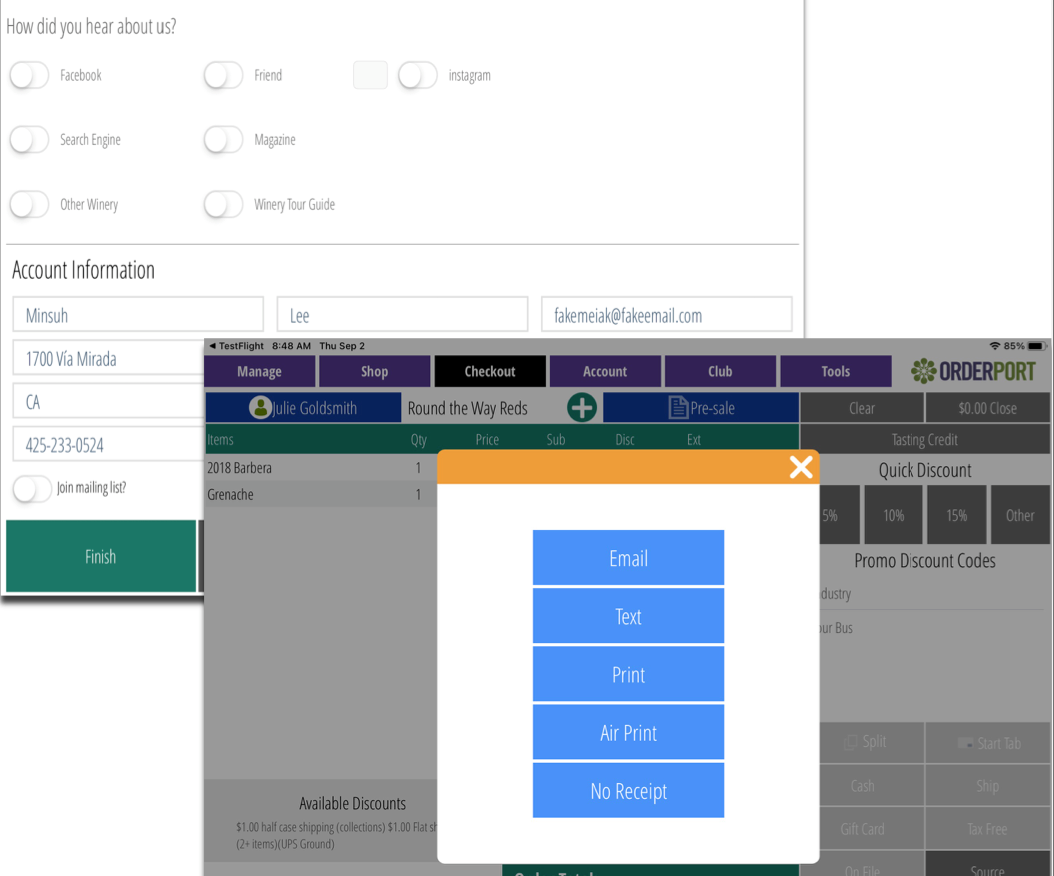
Completing a Transaction:
After tapping Next, the Complete Checkout screen will appear. Here you can capture customer information, print or send a receipt, and finalize the transaction.
Once you tap Finish, you will be redirected to the Manage screen.
If the customer has an account, receipt options will appear directly on the checkout screen. Select the customer’s preferred option, and you will be redirected to the Manage screen once the process is complete.
Running a Tab
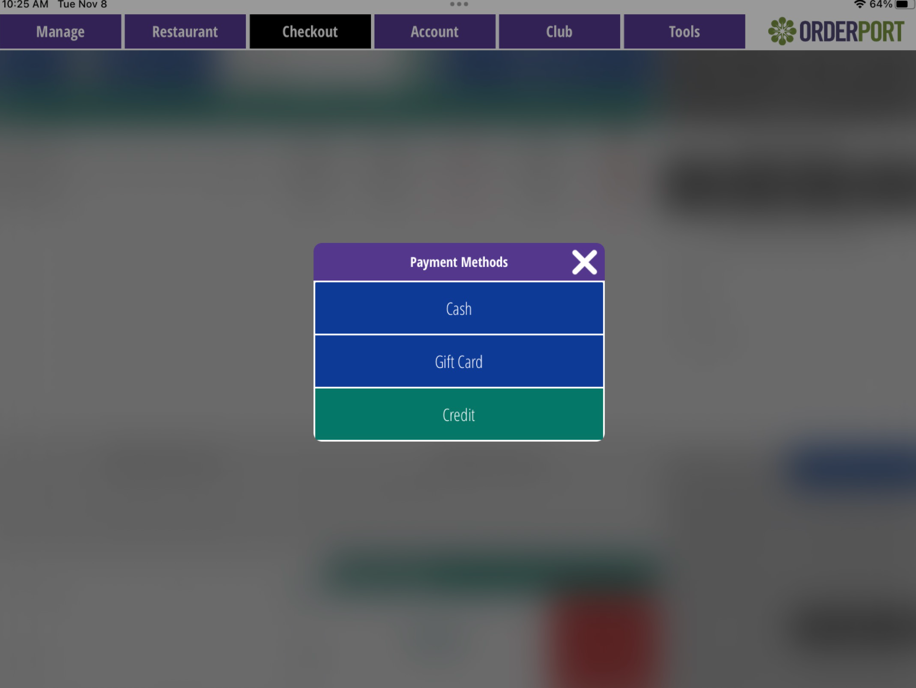
Once you reach the Checkout screen, instead of checking the customer out completely, select Start a Tab. You will need to choose the payment method for starting the tab. Watch this OrderPort University Video.
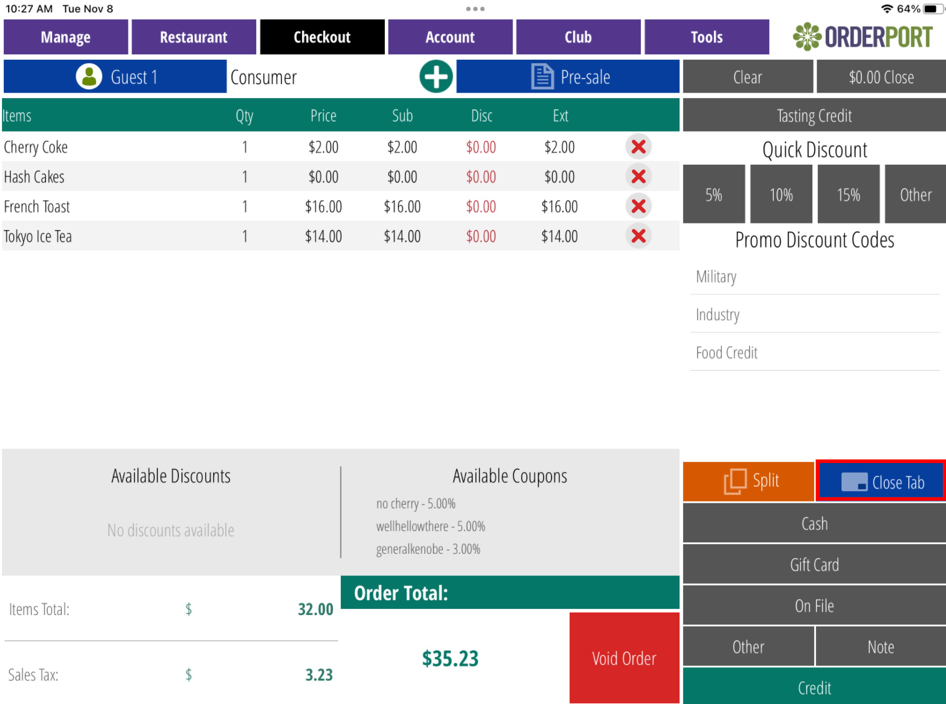
You can then continue adding products to the cart until the customer is ready to close their tab. When ready, go to Checkout and select the Close Tab button.
If the tab was started with a card, the system will ask if you want to close the tab with the same card. If you select Yes, the customer will be prompted to select a tip. If not, choose a different payment method and proceed with checkout.
Running a Split Transaction
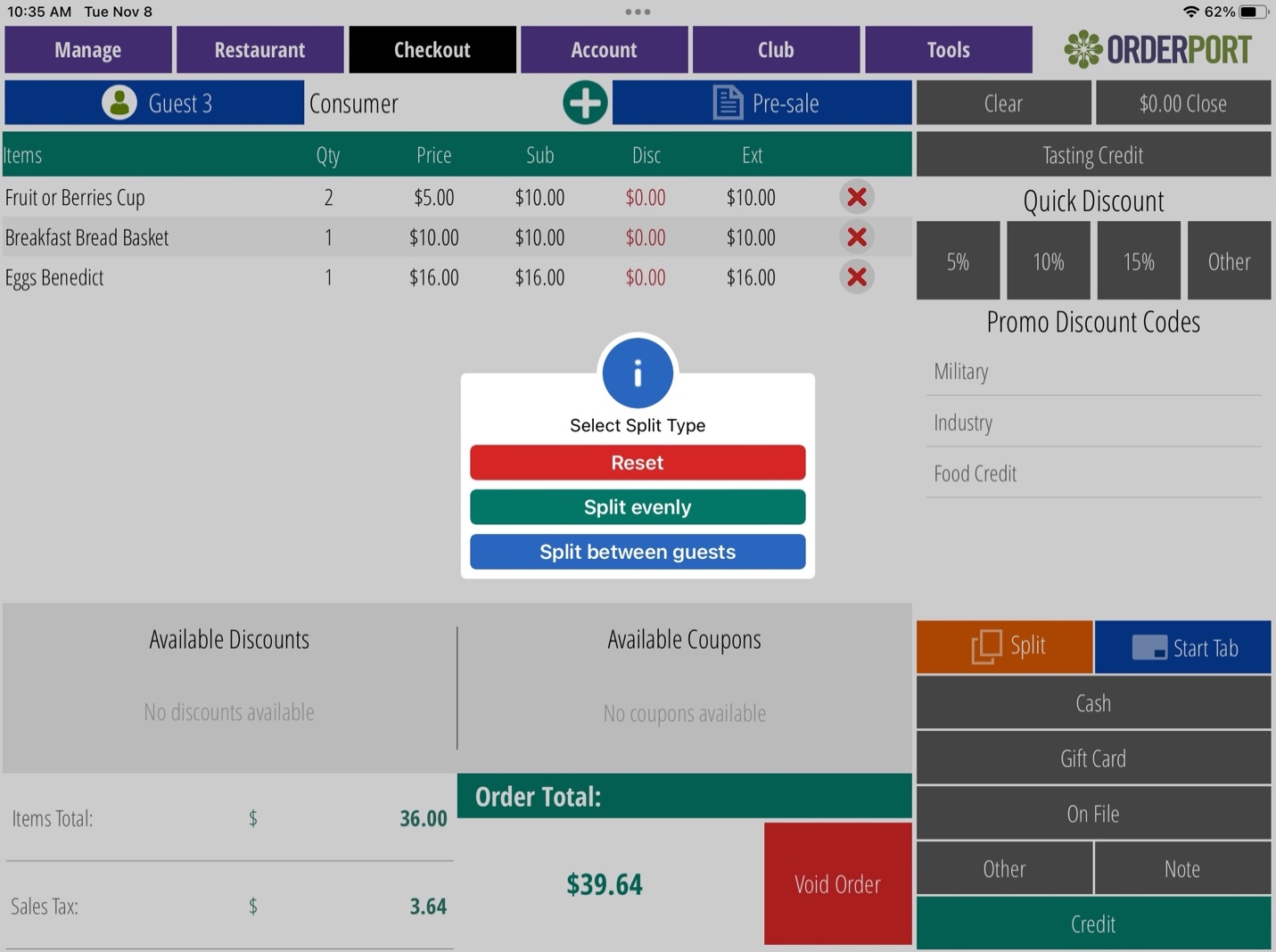
Once you have selected your products and the customers are ready to check out, select the Orange Split button on the checkout screen. You will be asked how you would like to split the transaction. You can choose to Split Evenly or Split Between Guests. Watch this OrderPort University Video.
Split Evenly:
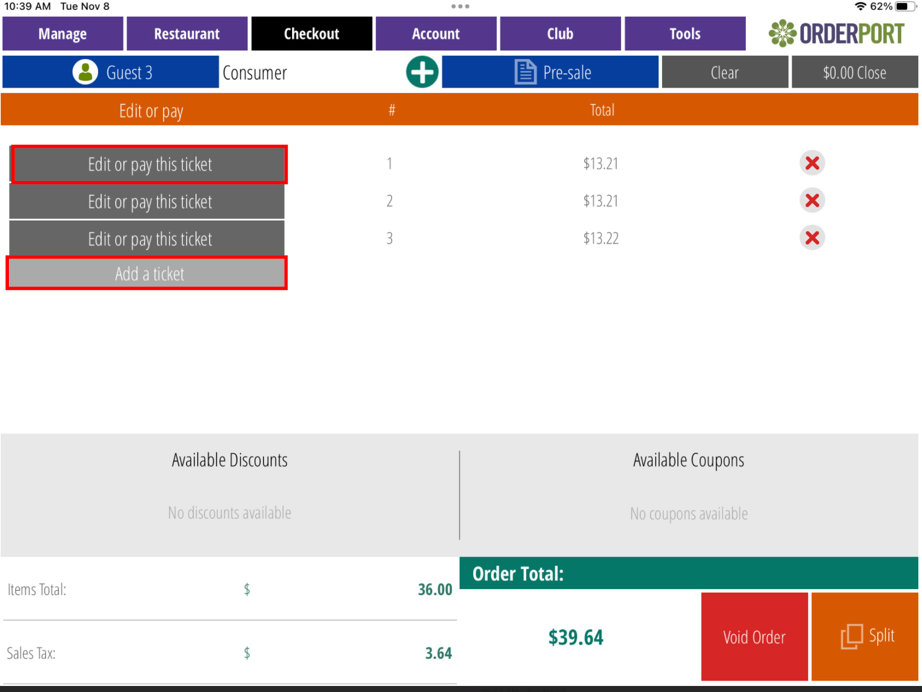
Selecting Split Evenly will bring you to a screen where you can choose how many ways to split the transaction. For example, if you want to split the transaction three ways, select Add a Ticket two times. When you are ready to pay a ticket, select Edit or Pay This Ticket. If necessary, you can adjust the ticket amount and then select the method of payment.
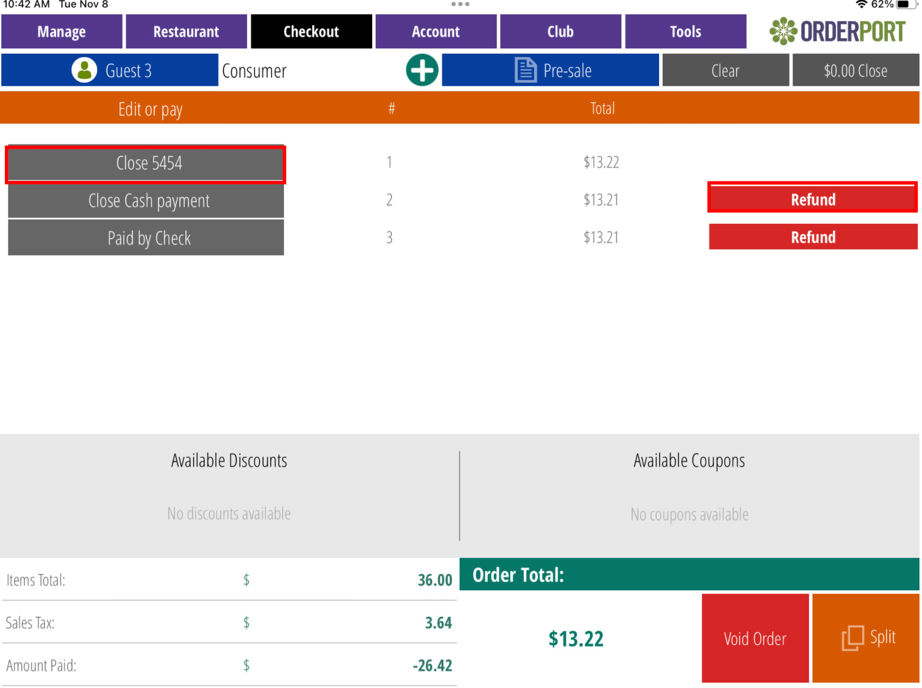
After all tickets are paid, you will need to close any tickets labeled Close. Closing a ticket is when the tip amount is entered. You can also refund an already paid ticket if a mistake was made.
Split Between Guests:
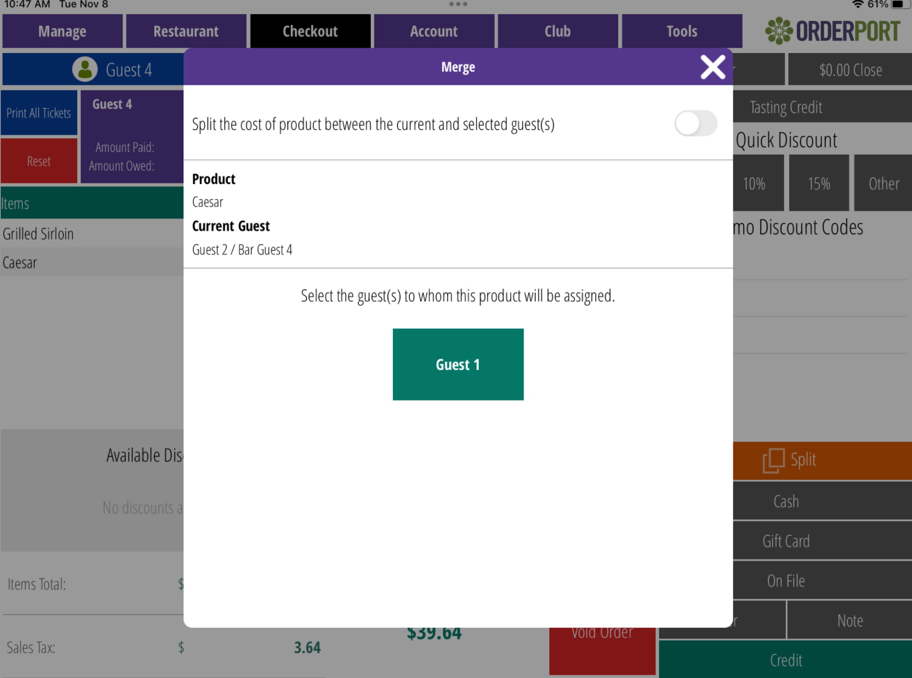
Selecting Split Between Guests will divide the ticket based on the products assigned to each guest. If a product is assigned to the wrong guest or you want to split the cost of a product between multiple guests, tap and hold the product. This will bring you to a page where you can either split the payment or reassign the product to a different guest.
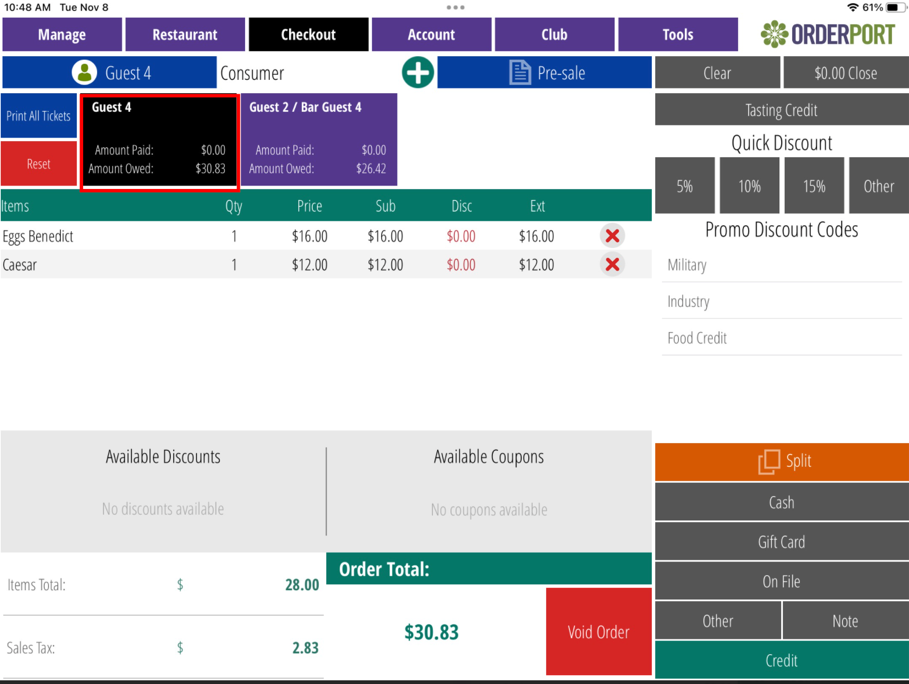
Tap on each guest at the top of the screen to pay for their ticket. The selected guest will be displayed in a black box, while all other guests will appear in purple. You will need to close each of these transactions individually.
Standard Payment Methods
When you are using the Point of Sale, there are many different payment methods available. Some of these require you to enable them in OrderPort Administration.
Credit Card – At checkout, select the Credit button. If you have a card reader connected, it will prompt you to insert or tap the card. If no card reader is connected, you will be prompted to manually key in the card number. This payment method will not save the card information unless you are using a tab.
Card on File – To check out using a card on file, you must be logged into an account that already has a card saved. At checkout, select On File to view the customer’s saved cards. Choose the desired card and click Proceed. Watch this OrderPort University Video.
Adding/Updating a Card on File – From the account page or the shop page, you will see a Card on File section. Clicking this will take you to the Card on File page. To add a new card, click Add. If a card reader is paired, you can tap or insert the card; otherwise, you will need to manually enter the card details. After entering the card number, select a billing address. To update an existing card, select the desired card from the list and click Update.
Cash – When you select Cash, enter the amount provided by the customer. If you have an electronic cash drawer connected, it will open once the amount is entered. Please note: before proceeding, review the change amount, as this is the only screen that displays the required change.
Gift Card – OrderPort offers a Gift Card module that allows you to sell both electronic and physical gift cards. If this module is enabled, you can enter the gift card number and proceed to checkout. Please note that when selecting Gift Card, there are two tabs at the top: Gift Card and Gift Certificate. Electronic gift cards are not gift certificates. Be sure to enter gift cards only in the Gift Card tab.
Gift Certificate – This payment method allows wineries to create their own gift certificates that are tracked outside of OrderPort. These may include mail-in ads or paper coupons for a specific dollar amount. To use this payment method, select Gift Card, then choose Gift Certificate.
Other Payment Methods
At checkout, there is a button called Other Payment Methods. This includes Member Account, Check, and any additional payment methods you have set up in the Payment Processing module. Watch this OrderPort University Video.
Check – This option allows you to enter a check number. After placing the order, you will need to approve that the payment was received in OrderPort Administration.
Account – Member Account funds function like in-store credit. In the Point of Sale, on the Shop screen, any available customer funds will be displayed on the right-hand side of the screen. Customers can earn these funds through refunds and subscription clubs. For more information, please watch the related OrderPort University video.
Selling Gift Cards
Create a gift card product and add it to a Point of Sale group. For more information on creating gift card products, please review this guide. After the item is available in the Point of Sale, adding it to the cart will prompt you to select whether the gift card is physical or electronic. If you choose a physical gift card, you will need to enter the physical card number at checkout. For more information, please watch the OrderPort University video.
Reservations
In order for the Reservations feature to be available in the app, you must enable the Reservations Module. To do this, please contact helpdesk@orderport.com. Review the Restaurant Setup Guide and OrderPort University training to complete this setup. Please watch this OrderPort University Video.
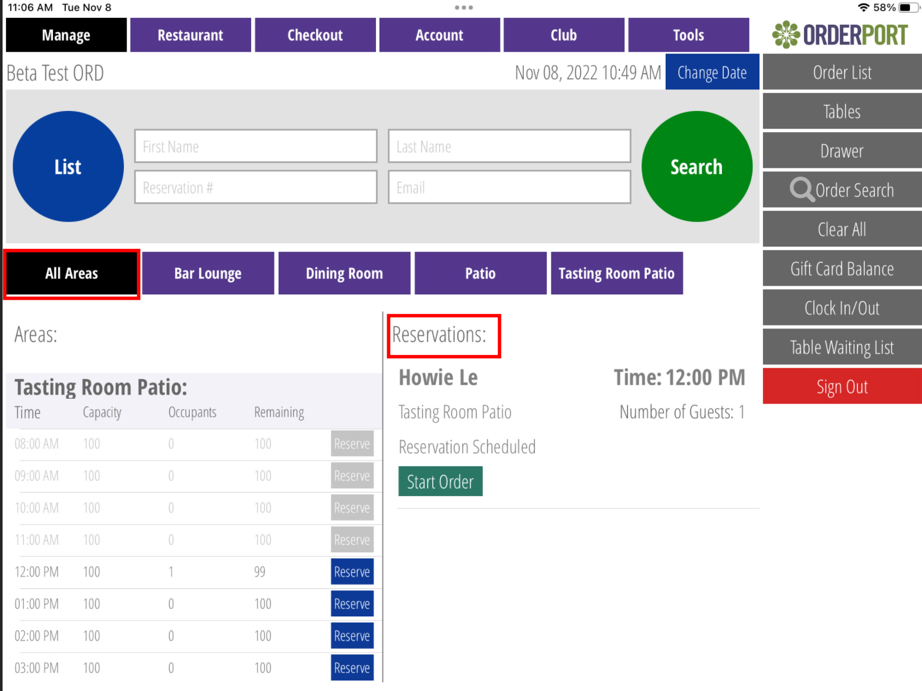
Viewing Existing Reservations:
The Reservations tab on the OrderPort app allows you to view existing reservations. On the right-hand side of the app, in the gray bar, there is a button labeled Reservations. Selecting this will take you to a screen displaying all reservation areas for the current tasting room location.
Any existing reservations will appear under the All Areas tab in the Reservations section. This allows you to see everyone scheduled to visit the tasting room today. You can click through the areas to view the seating area or experience they selected on the webstore. To view reservations for a different date, select the blue Change Date button at the top of the screen.
Capacity View:
There are two different views for the All Areas list. The first and default view is the Capacity View.
List View:
The second view option is the List View. To switch to this view, select the List button at the top of the screen.
Creating New Reservations:
If you need to create a new reservation, you can do so through the app. First, select the area where the customer wishes to be seated. The process will differ depending on whether the area uses tables or not.
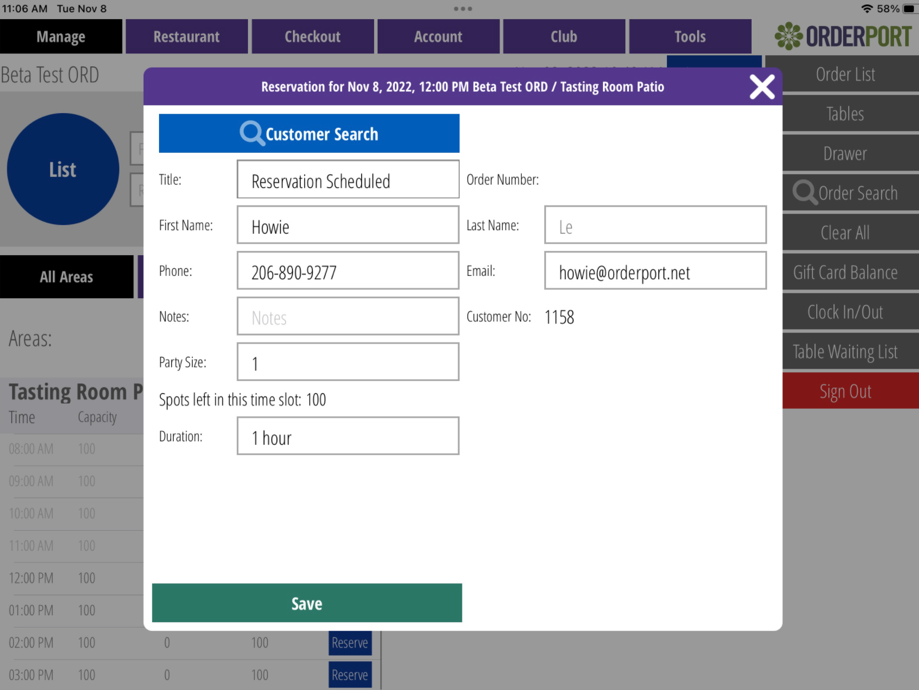
With Tables:
After selecting an area with tables, you will be brought to the table grid, where you can select a table and a time slot for the reservation. Open tables are shown in green. After selecting a time slot, a pop-up will prompt you to create the reservation. From here, you can search for an existing customer or manually enter their information.
Without Tables:
After selecting an area without tables, you will be taken to a screen displaying all available time slots. Select one of the blue Reserve buttons. From here, you can search for an existing customer or manually enter their information.
With Product Purchase:
If the selected area requires a product purchase, after clicking Save, you will be prompted to select products. If you select zero-dollar products, you will need to click Save again to complete the reservation. If you select products with a required deposit, you will be taken to a screen showing the total amount owed. After getting approval from the customer, select Complete, and you will be prompted to choose a payment method.
Canceling / Editing Reservations:
To edit an existing reservation, locate it under the All Areas tab and click on the customer’s name. This will open the reservation, allowing you to add guests, adjust the reservation status, or change the reservation time.
To cancel a reservation, select the Status tab and choose Canceled.
To change the date or time of a reservation, select the blue Change Time button. A calendar will appear, allowing you to select the new date and time.
Seating Customers:
When the customer arrives at the tasting room, select Start Order. You can adjust the number of guests and assign a table when seating them. This will create a light blue order that includes any pre-selected items.
Table Map
The OrderPort Table Map provides a visual and interactive view of your table layout. To access this from the OrderPort Five app, select the Tables button. If you have multiple maps, scroll left or right to view other areas. Green tables are available and ready for customers. After selecting a table, you can search for the customer and enter the number of guests.
If you select too many guests for a table, the app will notify you to select an additional table or indicate that the table is not combinable.
Once all requirements are met, select Seat Guests.
Table Map Starting Screen:
In the Point of Sale module of OrderPort Administration, you can set the landing page for each location under the Settings tab. Set the landing page to Table Map to have it display when opening the app.
Table Map Editor:
Table maps and layouts are customized in the Point of Sale. In this way, you can have customers reserve specific tables that are tied to physical locations. Only users with reservations module access on OrderPort admin will have access to the table maps. Go to the Tools tab, then tap Table Maps.
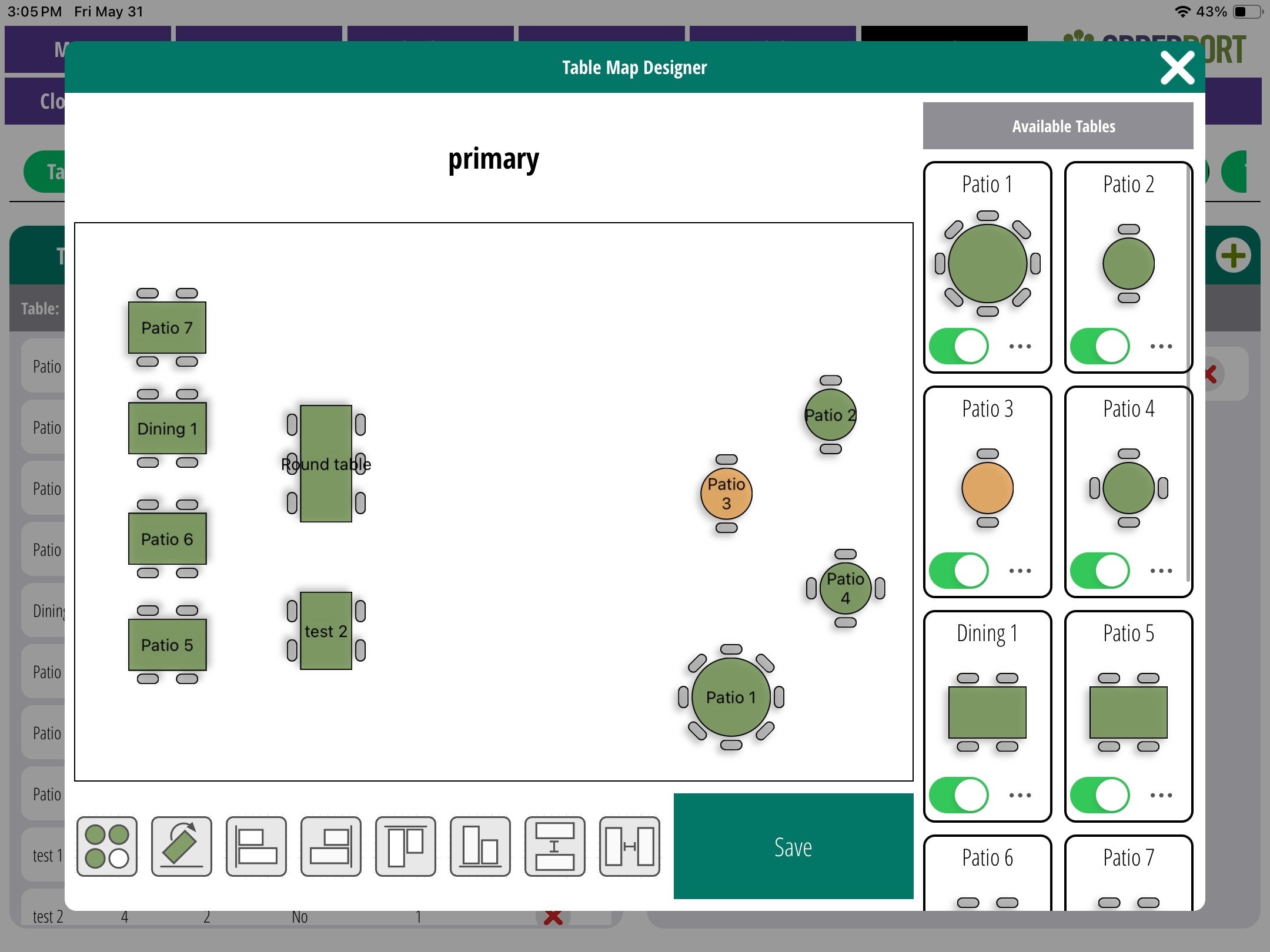
You will see each area listed on the top of this tab. Each area will have a list of tables. On the right, you will find the layout settings. By tapping on Map, you can choose how these tables are mapped. By setting up the map to be similar to the physical space of the area, you can easily associate reservations and customers with tables.
On the right, you can toggle tables and change the style of the tables by tapping on the three dots. You can take these tables and drag them across the screen to move them. For advanced features, you can use the buttons at the bottom. The first button allows you to select more than one at a time. After selecting tables, you can apply any of the other transformations on those tables. Once finished with your customizations, tap save.
Table Alignment.
 Toggles between single selection and multi selection.

45-degree Rotation

Left Alignment

Right Alignment

Top Alignment

Bottom Alignment

Space in between vertically

Space in between horizontally
Waiting List
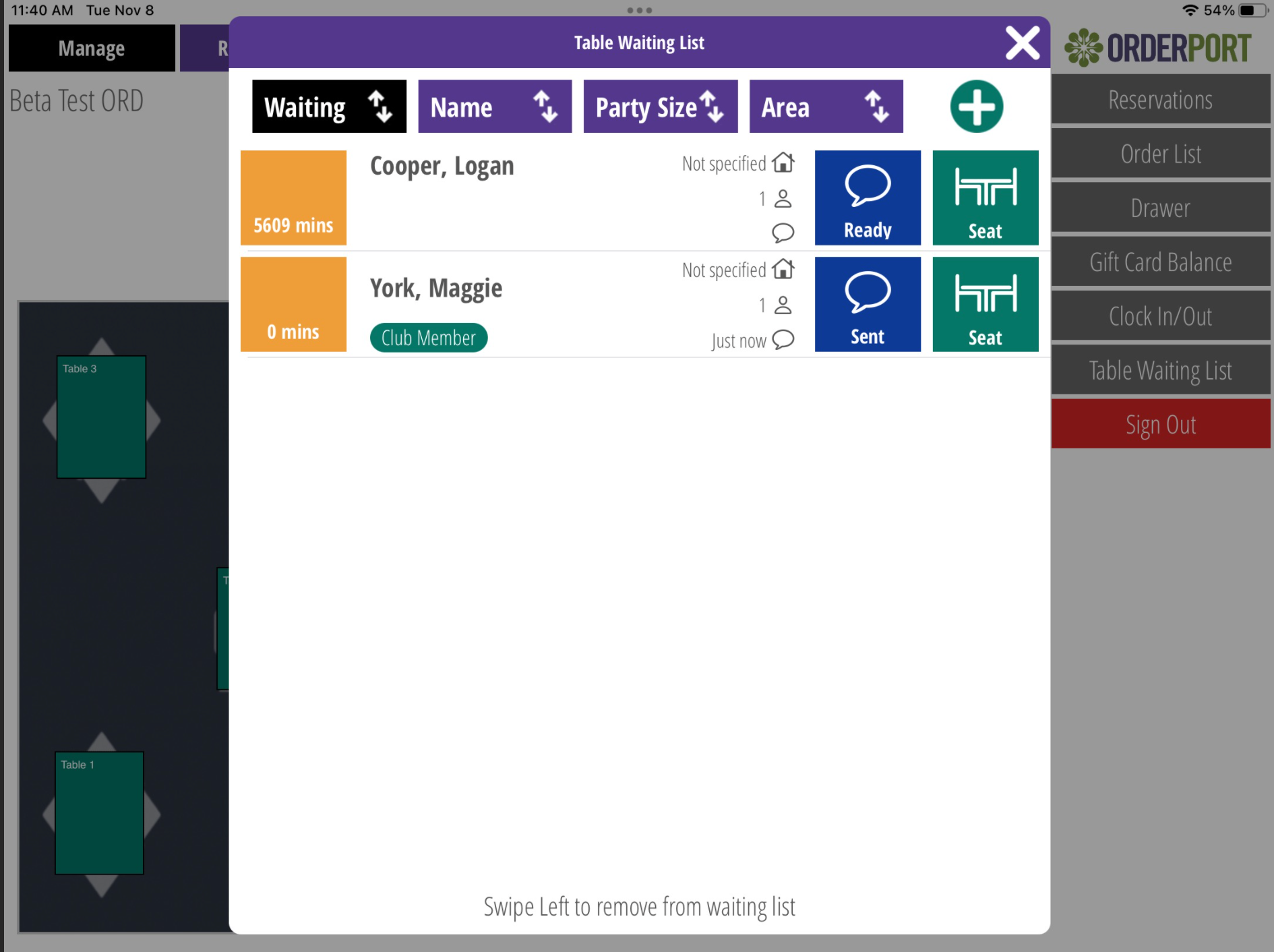
OrderPort Restaurant includes a Table Waiting List button on the left-hand side. This feature allows you to add customers to a waiting list. The list shows how long each customer has been waiting and allows you to seat them directly from this page.
If the customer provided a phone number, you can send them a text message using the Ready button.
Creating a Customer Account
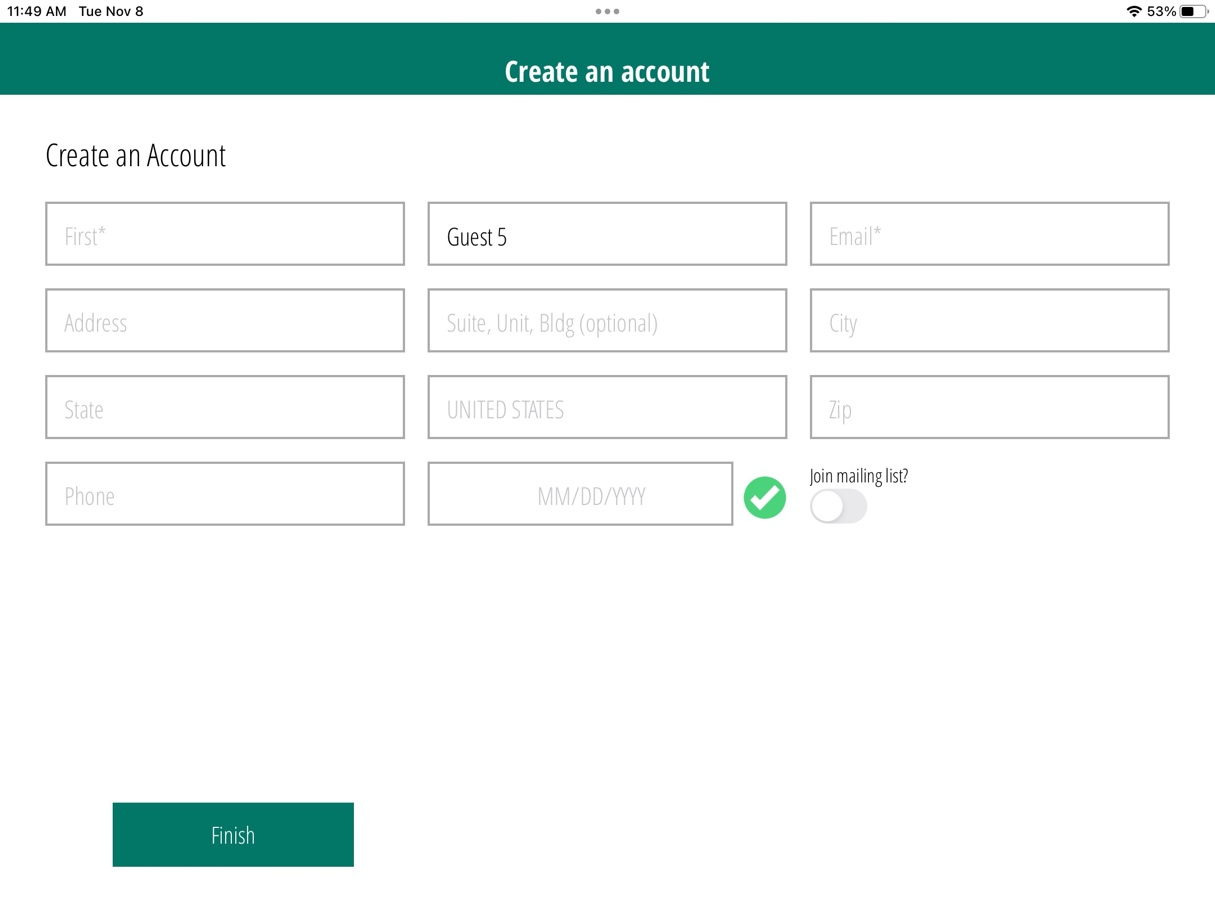
If you are checking out an order for a customer who does not have an account with the winery, you can set one up after the transaction is complete. At the end of every guest order, you will be directed to the Create an Account page. Enter at a minimum the customer’s first and last name, along with their email address. Please watch this OrderPort University Video.
Adding a Wine Club Member
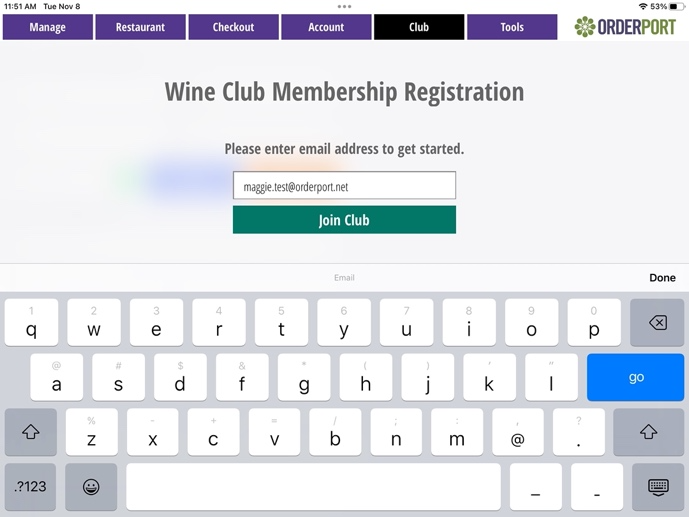
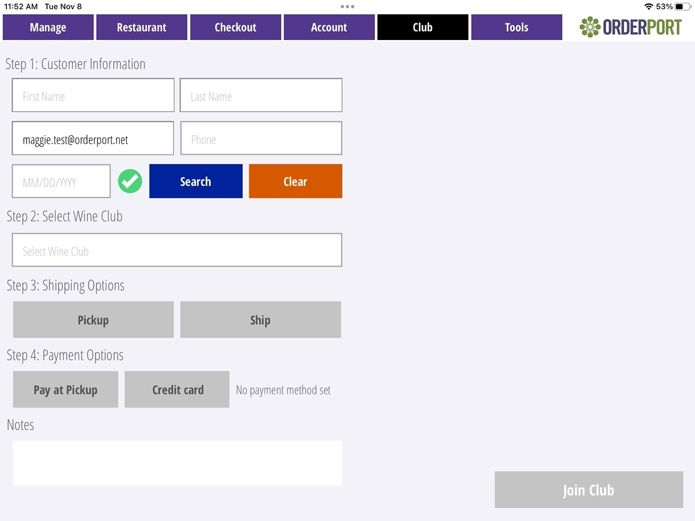
From the app, select the Club tab. This will take you to a page where you can enter an email address. If the email is attached to an existing account, the customer’s account will appear, allowing you to add a new club membership. If the email is not associated with an account, you will be prompted to enter all account information and select their wine club. Watch this OrderPort University Video.
Shipping an Order
To ship wines from the tasting room, add all products as if creating a normal order. Note: This must be done as a separate transaction from any in-house purchases. Please watch this OrderPort University Training.
Step One: Checkout Screen
To ship, you must be on the Checkout screen. Ensure all products are added prior to shipping. You can edit an already processed order if you need to ship that order. On the checkout screen, on the left side, you will see payment method options. Among them, there is a Ship button.
Step Two: Estimated Rates Screen
After selecting the Ship button, you will be brought to the Estimated Rates screen. This page allows you to enter a zip code to see approximate shipping costs. It also provides a list of states your winery can ship to, helping you confirm shipping eligibility without entering all customer information.
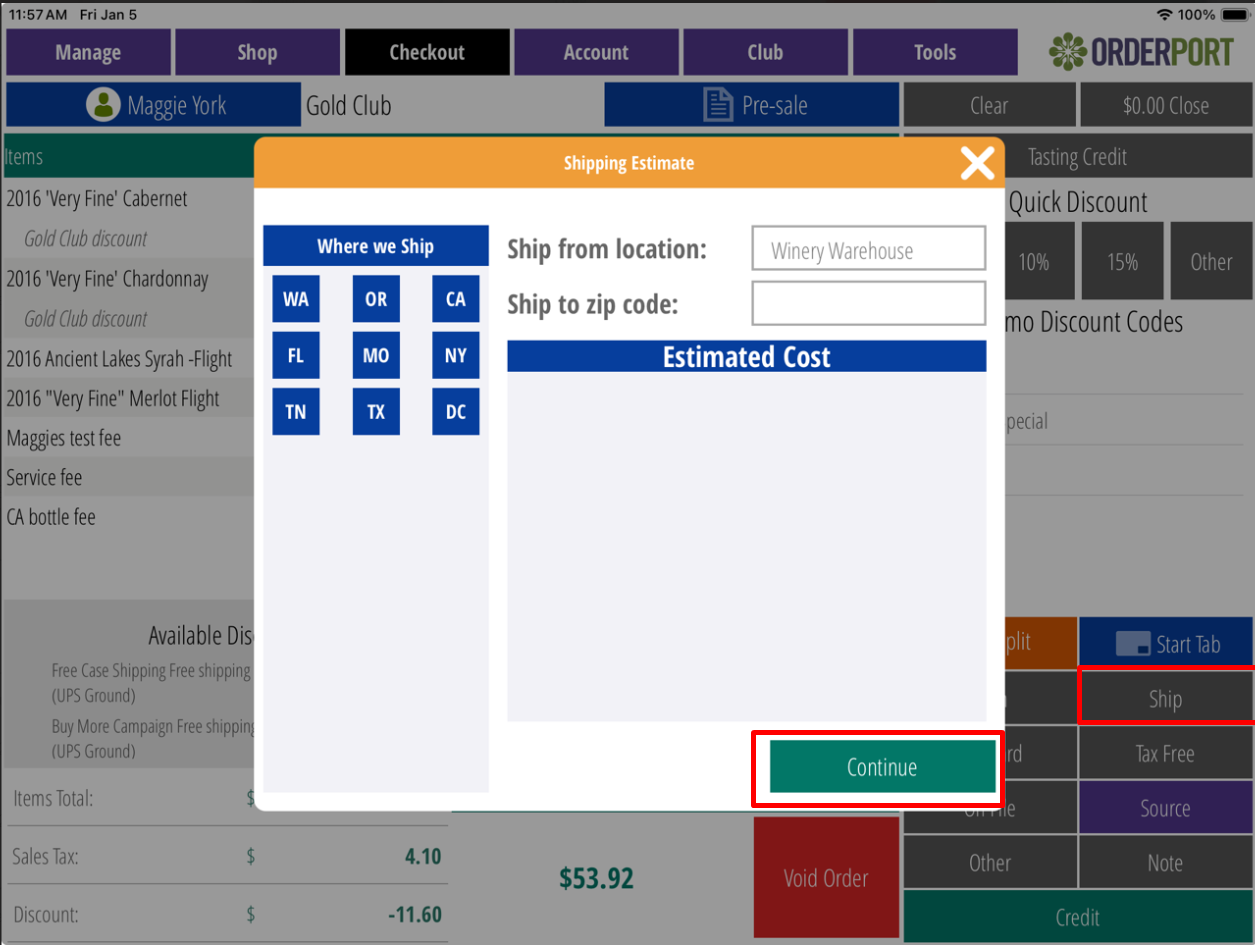
This step is optional; you can select Continue without entering a state or zip code.
Step Three: Billing and Shipping Address
If this order is assigned to a customer with saved billing and shipping information, it will auto-populate. If no customer is assigned, select the Search Customer button to see if they have an account to assign to this order. An account is not required; shipping information can be manually entered. Keep in mind that many shipping carriers require a phone number and birthday in the shipping address. When finished, select Save and Continue.
Step Four: Selecting Shipping Rates
All available shipping methods for the address will populate along with the carrier rates. Select the desired method. If shipping at a later date, you can add a Future Ship Date on this page. Click Continue.
Optional: Manually Adjusting Shipping Price
After shipping has been applied to an order, if you need to manually adjust the price, navigate to the Checkout screen. Next to the shipping cost, there will be an orange pencil icon. Click it to adjust the price. Make sure to Save after making changes.
Updating and Reviewing Customer Accounts
If you need to review or adjust any of your customer's account information, you can do so through the Account tab. On the right-hand side, there is a blue Search Customer button. From here, you can view their name, email, customer class status, birthday, and phone number at the top of the screen. Directly below this are some light blue buttons.
Customer Details:
Here you can view recent purchases, favorite items, loyalty points, account notes, and their club membership. If you need to adjust someone’s club membership, you can select it from this page. You can Update, Change, or Cancel their club membership.
Order History:
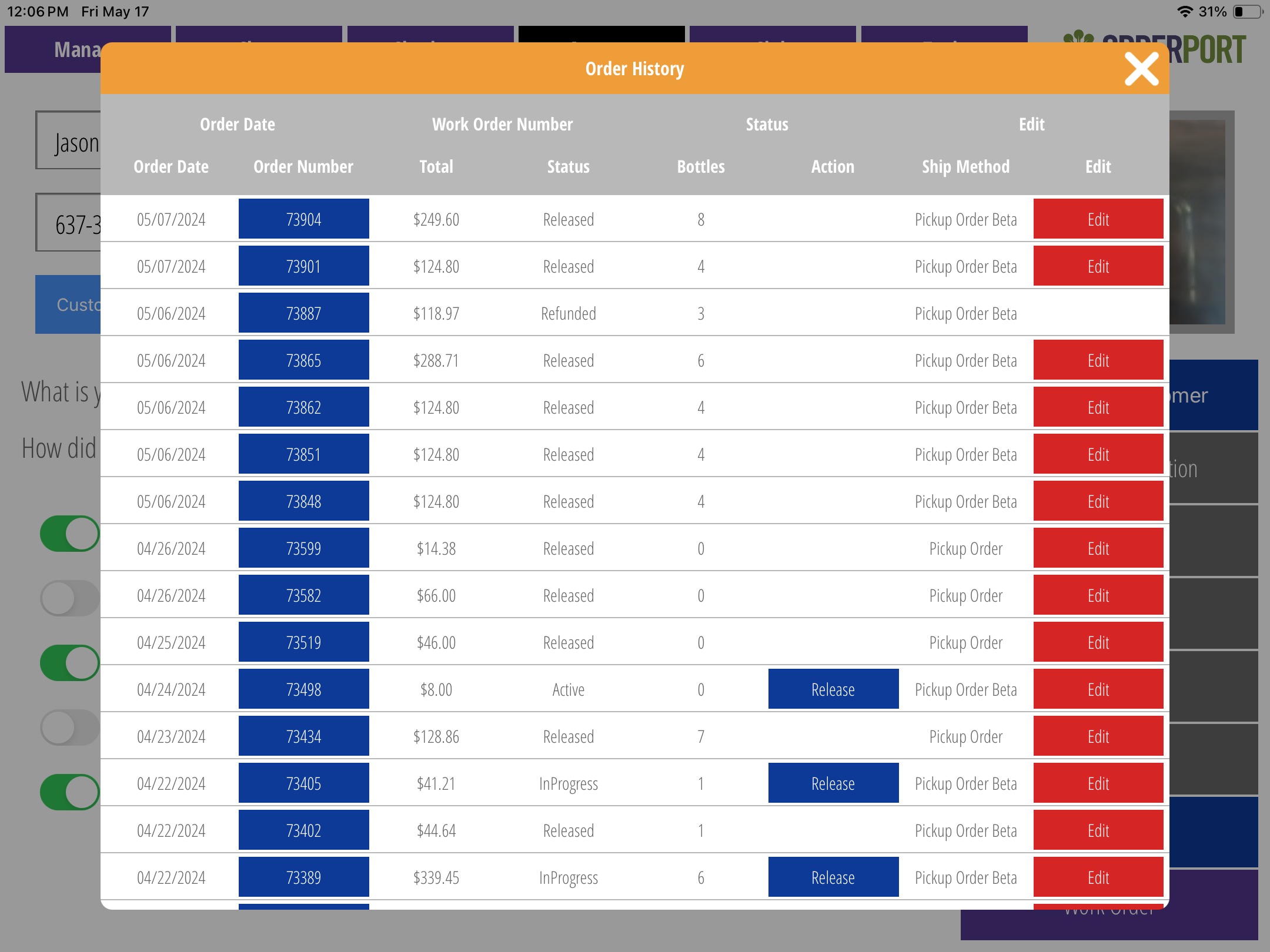
Here you can view order details, edit orders, release pick-up orders, and take payment on unpaid club orders.
Credit Card:
Here you can Add, Update, and Delete cards on file. You can also assign a card on file as the default card for a customer’s Wine Club account.
Address:
Here you can update customers’ shipping and billing addresses. Secondary addresses can also be added.
Releasing Pickup Orders
If a customer needs to pick up a wine club order, you can release it through the Account tab. After searching for the customer, select the Order History button. You will see a list of all the customer’s associated orders. Next to each order that needs to be picked up is a blue Release button. Please watch this OrderPort University Video.
Refunding a Transaction
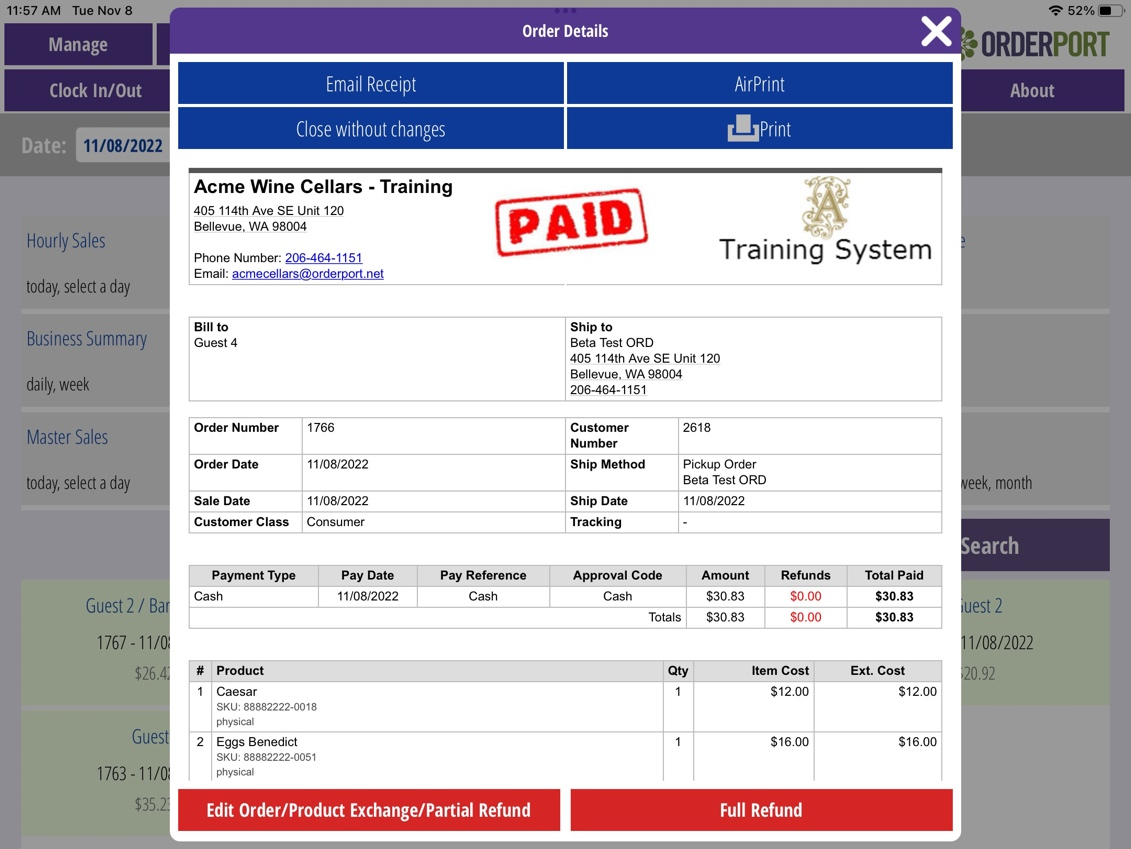
To refund a transaction, navigate to Tools and then the Reports tab. At the bottom of the page, you will find the Completed Orders tab. Tap the order and select Full Refund. Watch this OrderPort University Video.
If you need to make a partial refund or edit an order, you can do so by selecting Edit Order.
Editing an Order
To edit an order, navigate to Tools and then the Reports tab. At the bottom of the page, locate the Completed Orders tab. If you are searching for a previous order, you can change the date at the top of the page. Tap the order and select Edit Order. Please watch this OrderPort University Video.
You can:
- Add or remove items
- Change item prices
- Add or remove shipping
- Edit the shipping price
- Add or remove sales tax
- Add a new shipping address or change the shipping method
While the order is open in the POS, it will appear on the Manage page in red. In the admin section, it will be marked as "OpenForEditOnPOS", preventing multiple people from editing the order simultaneously.
You can also edit an order through the Account tab. After searching for a customer, select the Order History button. A list of all the customers’ associated orders will appear. Next to each order is a red Edit Order button.
Physical Inventory Count
The inventory count is completed in the Point of Sale. Open OrderPort on your device, log in, go to the Tools tab, then navigate to the About section. The last button on the right is Physical Count.
Enter the physical product count in the field on the right for each product being counted. Any products left blank will be ignored for this count.
To narrow down the product list, use the Filter By button or the search function. Once finished, tap Count Completed. For more information, please watch the OrderPort University video.
Clock In / Clock Out
Clocking In
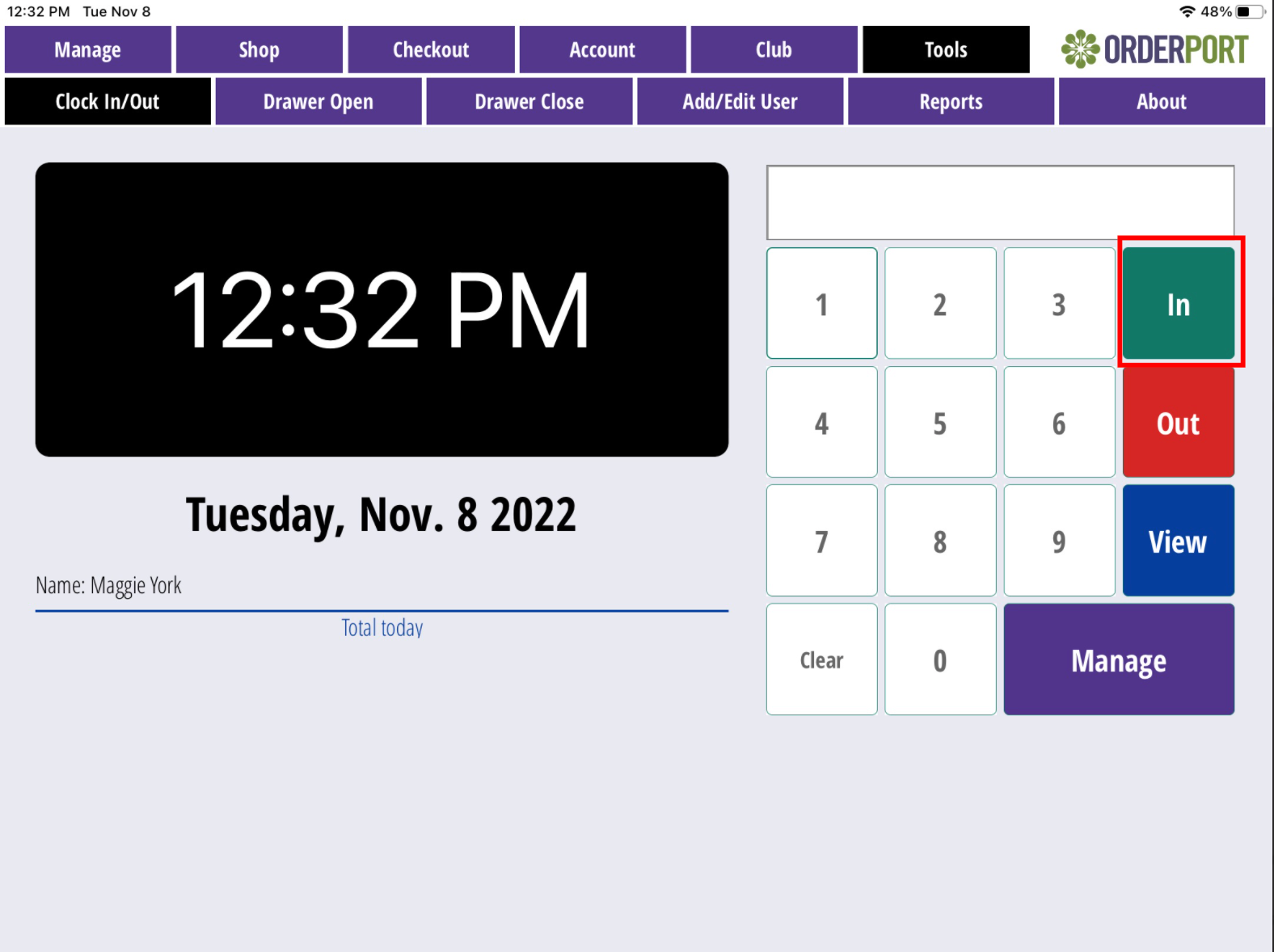
On the left-hand side of the app, there is a Clock In/Out button. Selecting this will take you to the Clock In/Out page. Enter your PIN and select the green In button. Please watch this OrderPort University Video.
Clocking Out
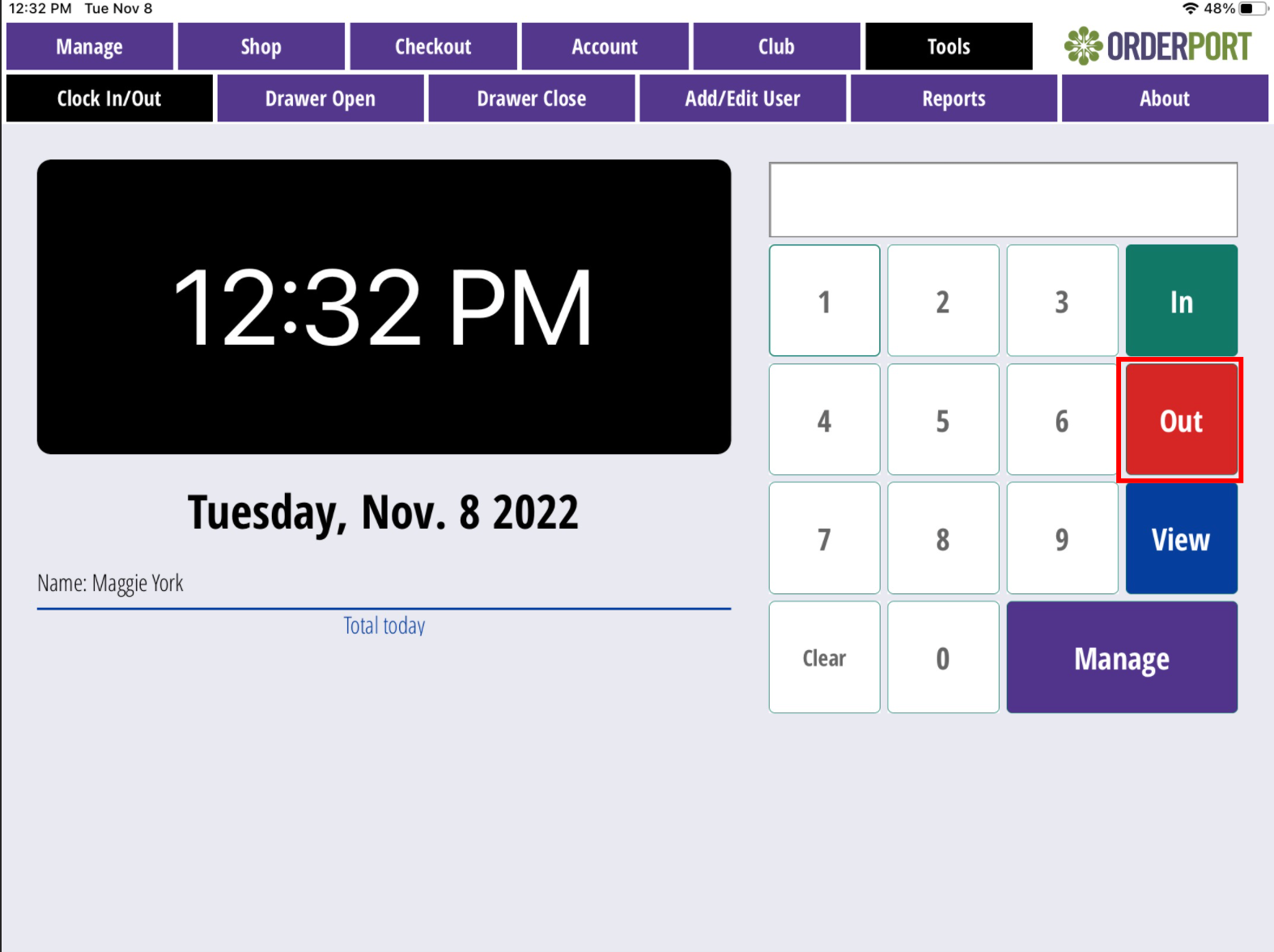
On the left-hand side of the app, there is a Clock In/Out button. Selecting this will take you to the Clock In/Out page. Enter your PIN and select the red Out button.
View
This button is accessible to all users. It displays the current employees who have clocked in, along with their recorded hours for the day, week, and month.
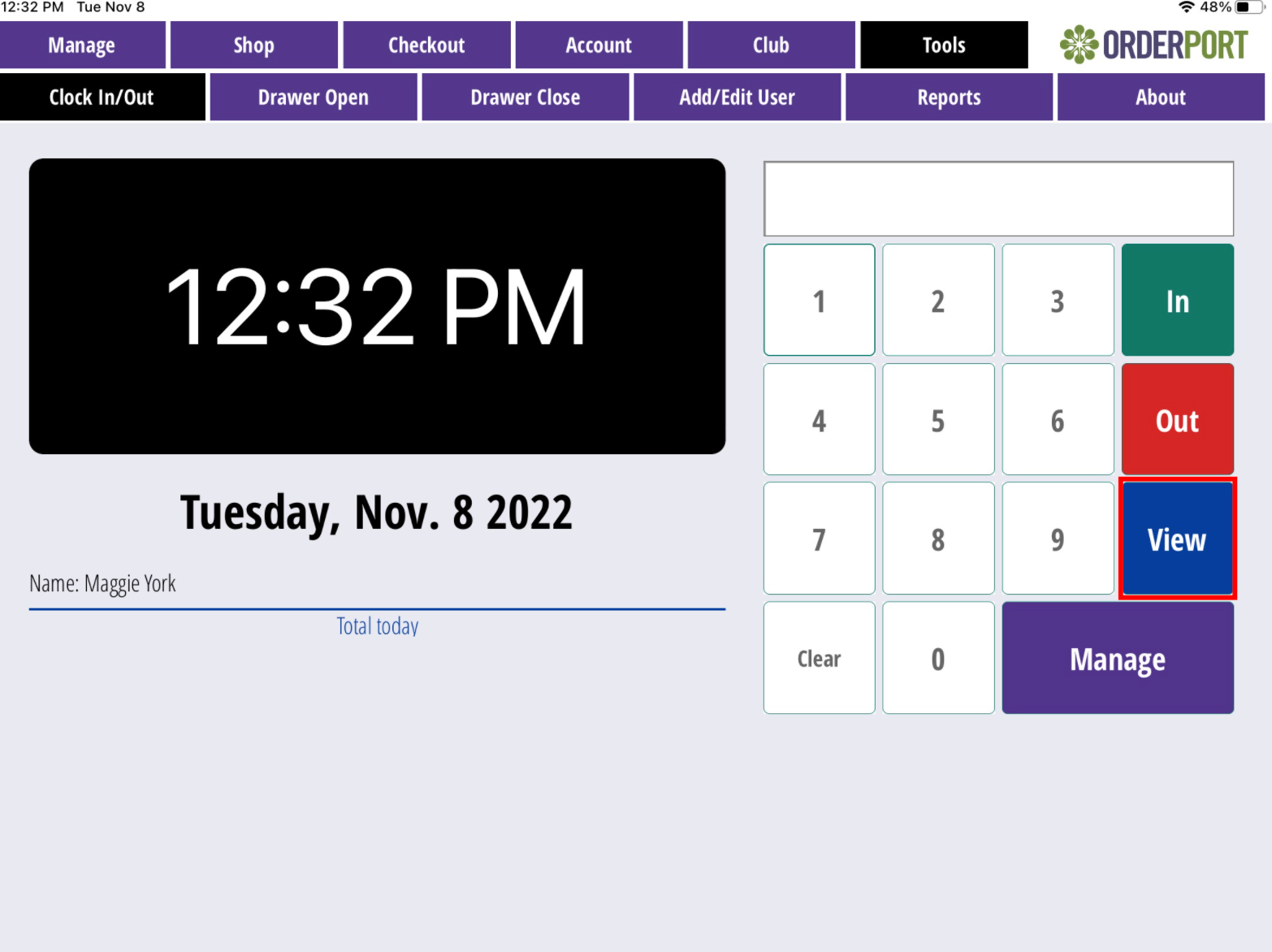
Manage
This button is accessible to managers only. Here, you can view and edit an employee’s existing timecards. Select the Edit button on the desired day, then choose the employee you want to edit.
Use the Add In/Out button to create a new adjustment, or select one of the existing In/Out entries to edit a current time slot.
Drawer Open
This report should be reviewed every morning before opening for business. It will auto-fill with the last saved information from the previous day. The values shown should match the cash in your drawer at the start of the day. Please watch this OrderPort University Video.
Drawer Close
This report should be completed daily after the store closes. The amounts should match the total number of bills, coins, checks, and credit card transactions processed throughout the day.
Reports
Reports can be accessed under Tools > Reports, in the section labeled Available Reports. This section contains all reports available within the Point of Sale.
If you need a report that is not listed here, it must be run through OrderPort Administration. To run a report, tap the desired report, and it will automatically generate for the current day. You can run reports for a different date by selecting Change Date after a report has run.
The Cash Drawer Open and Cash Drawer Close reports in this section are not adjustable. To make adjustments, use the Cash Drawer Open and Cash Drawer Close tabs.
Devices
OrderPort Restaurant is compatible with BBPOS card readers, Socket Mobile barcode scanners, and Star printers. For more information on which versions are compatible and how to set them up, please review the guides and training videos below.
Card Readers:
Pairing Guide and OrderPort University Video
Printers:
There are two ways to set up your printers. The first is the standard Wi-Fi connection, and the second is cloud printing. For restaurant users, we strongly recommend cloud printing.
Standard: Pairing Guide and OrderPort University Video
Could Print: Setup and Pairing Guide
Barcode Scanners:
Pairing Guide and OrderPort University Video
FAQ's
Course Error
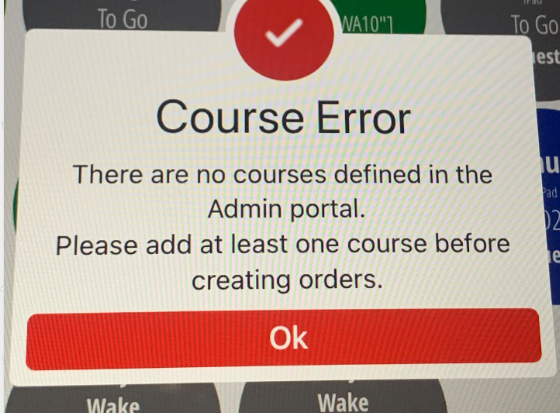
In order to use the Restaurant app, you need to have a minimum of one defined course. You can add courses from OrderPort Administration in the Point of Sale Module under the Courses tab.
Why Does My Restaurant App Look Scrunched Up?
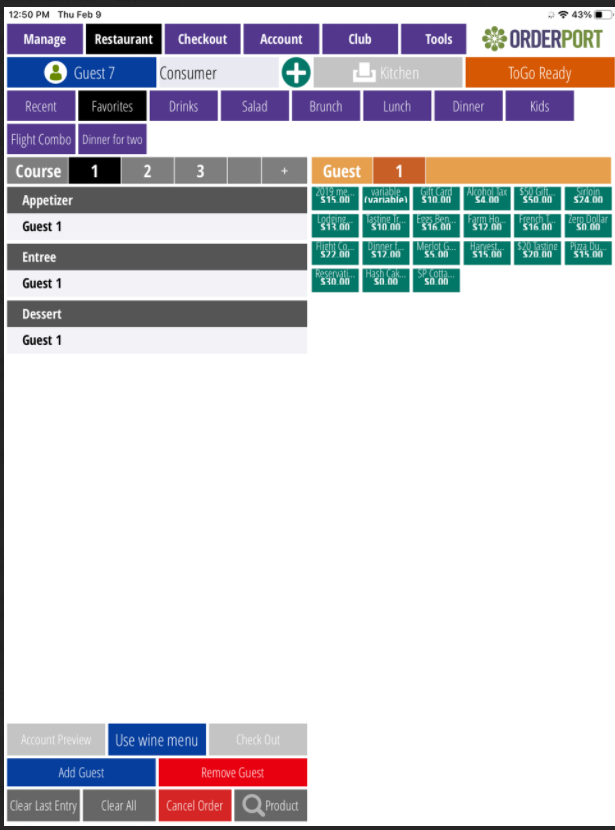
The Restaurant app is intended to be used in landscape mode only. Navigate to the Manage screen and rotate your device into landscape mode.
If nothing happens, your screen rotation may be locked. You can disable screen lock in your iPad’s Settings.