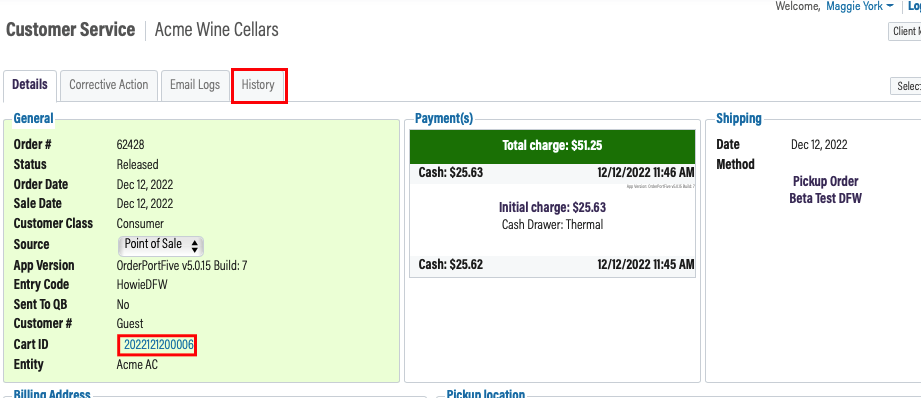
Every Order created has a section called "History." If an order was placed at the point of sale, it will have a Cart ID that is linked to the Basket event history. The Basket event history consists of internal logs from OrderPort that detail what occurred during the order.
Where can you find the Basket event history?
To view the Basket event history of an order, you need to access the customer service module and locate the specific order. If you only have the Cart ID, you can search for it directly.
When you search by the Cart ID, click on the blue text at the bottom of the page. This will take you straight to the Basket event history.
Basket Event History Layout
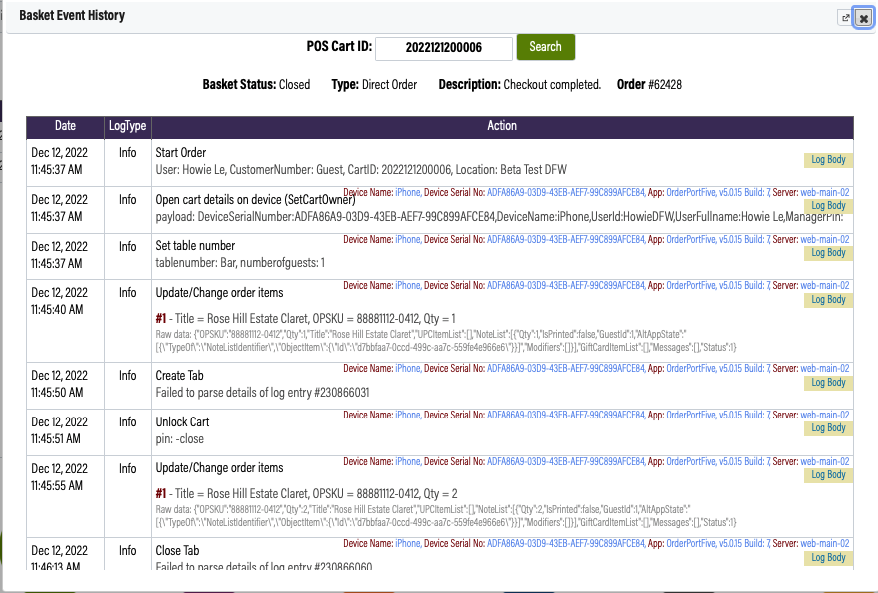
The basket event history is organized into four main sections. The first section appears above the table and includes the following components: Basket Status, Type, Description, and Associated Order Number.
Basket Status: Indicates whether the order is currently Open, being Edited, or Closed.
Type: Describes how the order was placed. If the order was made through the Wine Club, webstore, or an Admin cart opened on the POS, it will be specified here. Otherwise, it will be labeled as a Direct Order.
Description: Clarifies whether the order was completed or deleted without checkout.
Following the header information, you will find a table with three columns: Date, Log Type, and Action.
Date: Shows the date and exact time when each action occurred.
Log Type: Specifics the type of action taken, which is usually categorized as either Info or Error.
Action: Provides two pieces of information: the type of action performed and the device or app used for the action (noted in red and blue text).
Order Actions Overview
Actions are events that occur during the order process.
Start Order: This is typically the first action recorded in nearly every basket event history. If this action is missing, it likely indicates a split transaction. In the history tab, look for a note titled “Split by Guest Parent Cart ID.” This section provides information about the user who started the order, any applicable customer number, the cart ID, and the location where the order was initiated.
Open Cart Details on Device (Set Cart Owner): This action usually follows the Start Order. It indicates the assignment of the order to the user who created it, along with documentation of the device and app used to start the order.
Set Table Number: If the winery employs tables or a different order type, that will be displayed here. For instance, ToGo orders will be logged under a table number. This section also notes how many guests are included in an order.
Update/Change Order Items: This action records when and which products were added to the cart.
Update Items: This action reflects any adjustments or discounts made to a product's price.
Unlock Cart: This shows that the clerk returned to the manage screen and re-opened the transaction. If a PIN was required, it will be indicated here.
Set Discount: This action documents when discounts were applied to the order.
Apply Promo Code: This action notes when a promotional code has been used.
Log Payment Transaction: Payment transactions are logged when a credit card transaction is authorized. Each of these entries includes a button labeled "log body," which provides details about the card used and the amount authorized.
Create Tab: This indicates that a tab has been started. Similar to payment transactions, there is a "log body" button available that gives details about the card used and the authorized amount.
Close Tab: This action shows that a tab has been closed, also including a "log body" button for detailed information on the card used and the authorized amount.
Save Payment in OrderPort System: This action indicates when a credit card payment, often from a split transaction, has been saved in OrderPort. It details the amount, card, and user information.
Checkout: This action signifies that the order has been completed and indicates whether a payment method different from the credit card on file was used.
Split Cart Between Guests: This action lists all the cart IDs associated with this order.
Merge Guests’ Split Tickets: This action shows when split tickets were merged.
Delete Active Basket: This action indicates when a cart has been deleted.
This revised overview should provide a clearer understanding of the actions associated with order processing.