To send email through our system, you’ll need to add a few DNS records to your domain. If you’ve never done this before—no problem. Just follow the steps below.
TABLE OF CONTENTS
- What are DNS records?
- Finding your records in Orderport
- How to add DNS records
- Next Steps
- Additional Resources for Your Specific Domain Provider
What are DNS records?
DNS (Domain Name System) is where your domain settings live. This is usually managed where you purchased your domain or where your website is hosted.
Common providers include:
GoDaddy
Squarespace
Wix
Cloudflare
Google Domains (now managed through Google / Squarespace, depending on your setup)
Namecheap
Bluehost
HostGator
DreamHost
IONOS
Shopify (if your domain is managed there)
WordPress.com
Amazon Web Services (Route 53)
Microsoft (Azure DNS)
You’ll need to log into your DNS provider to add these records.
Finding your records in Orderport
In OrderPort admin > operations > Marketing > Settings, you will find the DNS records. These are the records you will need to add to your domain provider. If you need assistance, please contact our support line or submit a ticket at helpdesk@orderport.net. If you are unsure of how to add these records to your domain, whoever set up your domain should know how to do this.
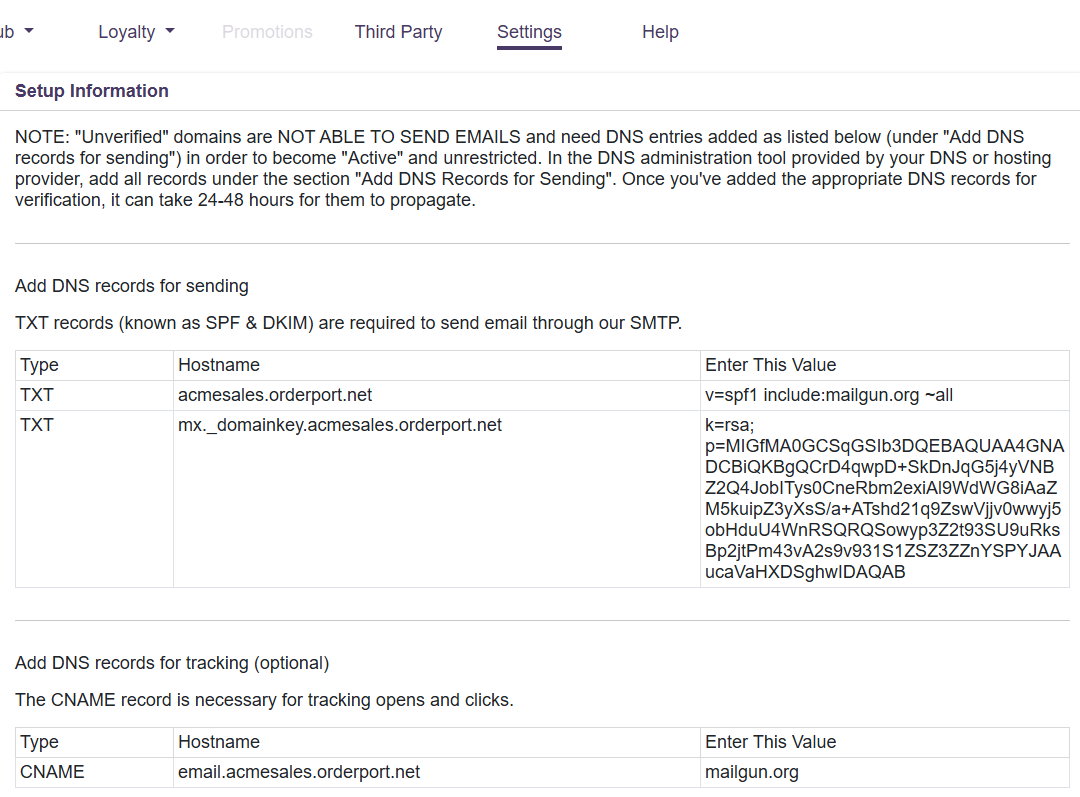
How to add DNS records
- Log into your domain/DNS provider
- Find DNS settings (may also be called "DNS Managment or Zone Editor)
- Click Add Record
- Select the Type (TXT or CNAME)
- Enter the Hostname and Value found in OrderPort
- Save the Record
Repeat this for both TXT records and the CNAME.
SPF Record (TXT)
The first record in the marketing module is your SPF or sending record. It is important to know that domain providers sometimes require differnt formats for their host names. Below are some examples of the SPF record.
Example Formats
| Type | Hostname | Enter This Value |
|---|---|---|
| TXT | @ | v=spf1 include:YOUR-SERVICE ~all |
| TXT | yourdomain.com | v=spf1 include:YOUR-SERVICE ~all |
| TXT | yourdomain.com. | v=spf1 include:YOUR-SERVICE ~all |
| TXT | (blank) | v=spf1 include:YOUR-SERVICE ~all |
Here is an example of how you should setup your SPF record.

Please note: when reviewing your records, if you already have an SPF record setup you will need to combine the records. As you can only have one record per domain.
Combining SPF records
| Type | Hostname | Enter This Value |
|---|---|---|
| TXT | @ | v=spf1 include:service1.com include:YOUR-SERVICE ~all |
When combing records, there are some special cases based on your domain provider. Typically, you can Google how your domain provider would like the hostname for your formated but here are a few common differeneces.
- @ represents the root domain
- Some providers require yourdomain.com instead of @
- Some providers allow the hostname to be left blank
- Some providers require a trailing "." while others do not
- Some providers require quotes around the value, others do not
- In rare cases, as a last resort, changing the order of the include statements can resolve issues
Example (swapped order):
This is a last resort if emails are still not sending.
| Type | Hostname | Enter This Value |
|---|---|---|
| TXT | @ | v=spf1 include:YOUR-SERVICE include:service1.com ~all |
DKIM Record (TXT)
The second record in the marketing module is your DKIM or sending record. It is important to know that domain providers sometimes require different formats for their host names. Below are some examples of the DKIM record.
| Type | Hostname | Enter This Value |
|---|---|---|
| TXT | selector._domainkey.yourdomain.com | k=rsa; p=YOUR_PUBLIC_KEY |
| TXT | selector._domainkey | k=rsa; p=YOUR_PUBLIC_KEY |
| TXT | selector._domainkey.yourdomain.com. | k=rsa; p=YOUR_PUBLIC_KEY |
There are some special circumstances with DKIM records and hostnames. If you are still having issues sending, please try some of these.
- Some DNS providers automatically add your domain
- Entering selector._domainkey may result in selector._domainkey.yourdomain.com
- If your record duplicates (example: yourdomain.com.yourdomain.com), remove the full domain from the hostname
- Some providers require a trailing "."
- Some providers require quotes around the value; others do not
CNAME Records
If you are interested in tracking clicks and opens for your emails, then you will want to verify your CNAME record as well. This is an optional record. It is important to know that domain providers sometimes require different formats for their hostnames. Below are some examples of the CNAME record.
| Type | Hostname | Enter This Value |
|---|---|---|
| CNAME | email.yourdomain.com | tracking.provider.com |
| CNAME | tracking.provider.com | |
| CNAME | email.yourdomain.com. | tracking.provider.com |
There are some special circumstances with CNAME records and hostnames. If you are still having tracking, please try some of these.
- Some providers automatically append your domain
- Entering email may result in email.yourdomain.com
- A CNAME record cannot exist with other records on the same hostname
- If you receive a conflict error, @helpdesk@orderport.net can change the hostname for you
- Example: email → tracking
- The exact hostname is flexible as long as it points to the correct value
- Some providers require a trailing ".", others do not
Next Steps
Reach out to OrderPort support and have them do a verification check. They will let you know if there is an issue with the reocrds or if they are verified.
Additional Resources for Your Specific Domain Provider
Do an internet search for, "How do I verify my domain with [Domain Provider Name]?" and then follow the documentation or reach out to their help center. Be sure you are verifying the domain you use as an email provider. In some cases, it's different from your website's domain.
Here are some documents from the most common domain providers:
GoDaddy
- Verify domain ownership: https://www.godaddy.com/help/verify-domain-ownership-dns-or-html-for-my-ssl-certificate-7452
- Manage DNS Records: https://www.godaddy.com/help/manage-dns-records-680
- Add a TXT Record: https://www.godaddy.com/help/add-a-txt-record-19232
- Add a CNAME Record: https://www.godaddy.com/help/add-a-cname-record-19236
Squarespace
- Manage and Add DNS Records: https://support.squarespace.com/hc/en-us/articles/205812348-Accessing-your-Squarespace-managed-domain-s-DNS-settings
- Verifying your Squarespace domain: https://support.squarespace.com/hc/en-us/articles/205812218-Verifying-your-Squarespace-managed-domain
Wix
- Manage and Add DNS Records: https://support.wix.com/en/article/managing-dns-records-in-your-wix-account
- Verify your WIX Domain with Google: https://support.wix.com/en/article/manually-verifying-your-domain-with-google-workspace-formerly-g-suite